
Shimza is South Africa’s great showman: a deeply technical and highly engaging DJ, who’s helped pioneer Afro-tech, and cross-pollinated global house sounds in his sets and productions. As he wraps an Ibiza residency and prepares his sophomore album, Ria Hylton speaks to Shimza and others in the South African electronic community to find out how confidence and collaboration are at the heart of his success
Ashley Raphala stands outside a house, listening to a DJ mix drift out from inside.
It’s the early ’00s, and mix compilations are shaping musical tastes up and down South Africa: Vinny Da Vinci and Christos are dropping ‘Deep House Sounds’ via their House Afrika label; Oskido is bridging kwaito and contemporary 4/4 with the ‘Church Grooves’ volumes; Glen Lewis is showcasing slower, soulful releases through his ‘Midtempo’ series. They’re all on radio too, testing out the newest house imports for upcoming compilations — on regional and national stations.
Raphala, still in his mid-teens, has spent hours absorbing all the releases, memorising transitions by heart — which is why this particular mix sounds both familiar and strange. Taken from DJ Fresh’s ‘Fresh House Flava 4’ (not to be confused with the UK DJ Fresh), Johnny Corporate’s ‘Sunday Shoutin’’, a Defected anthem, Soul Provider’s ‘Rise’, fresh out of Chicago, and Nick Holder’s classic ‘Summer Daze’ are all in there, but the order is new. He likes what he hears.
“I just stood across the road from the house because the DJ was so good — they’re playing music that I listen to almost everyday, but they’re doing it in their way,” Raphala, aka Shimza, tells DJ Mag. “The brother of Dj Khomza, the guy that taught me how to DJ, came out and said, ‘Hey man, I can see you standing there. You’re interested, come through, come see what we’re doing’.”
Raphala, still known by the nickname Shimi, had been to many stokvel parties — a South African savings club where members contribute to a shared fund on a regular basis and each member takes turns receiving the pooled money — so had seen DJs spinning up close, but inside the house is his first time behind the decks. “I’m closer to this DJing thing more than I’ve ever been,” he recalls. “Now I’ve got the opportunity to touch and learn, there’s no one else here but me and this guy. I had already written my DJ name — Shimza — on my school backpack with a marker, and he says, ‘So you can DJ?’ I said ‘Yeah’,” he laughs.

“If you’re travelling and you’re not learning then you are wasting time. I started travelling to play this African sound to the world, but I started learning how the world was working and seeing how I could incorporate what the world is all about into what I do.”
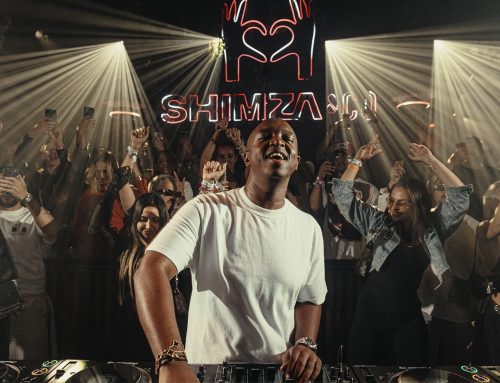
Fast forward to Christmas Day, 2024, and Shimza is preparing to play the final slot of his One Man Show. The festival, held in his township Tembisa — now Thembisa, north of central Johannesburg — marks the DJ’s annual homecoming. Throughout the day we hear every South African genre under the sun, as well as old-skool cuts — the kind you’d find in a compilation mix from years gone by. The legendary DJ Kent has spun, as have amapiano pioneers DJ Maphorisa and Kabza De Small, not to mention next-gen stars Zee Nxumalo and Kelvin Momo, but in the final hour the headliner picks up the pace. Ask anyone about Shimza and the first thing they’ll mention are his DJing skills. Cue drumming, cut mixing, echo fading, volume chops carried by trails of reverb — sometimes two tricks layered at once… his mixer work is fluid and exact, constantly finding ways to build tension and add rhythmic textures.
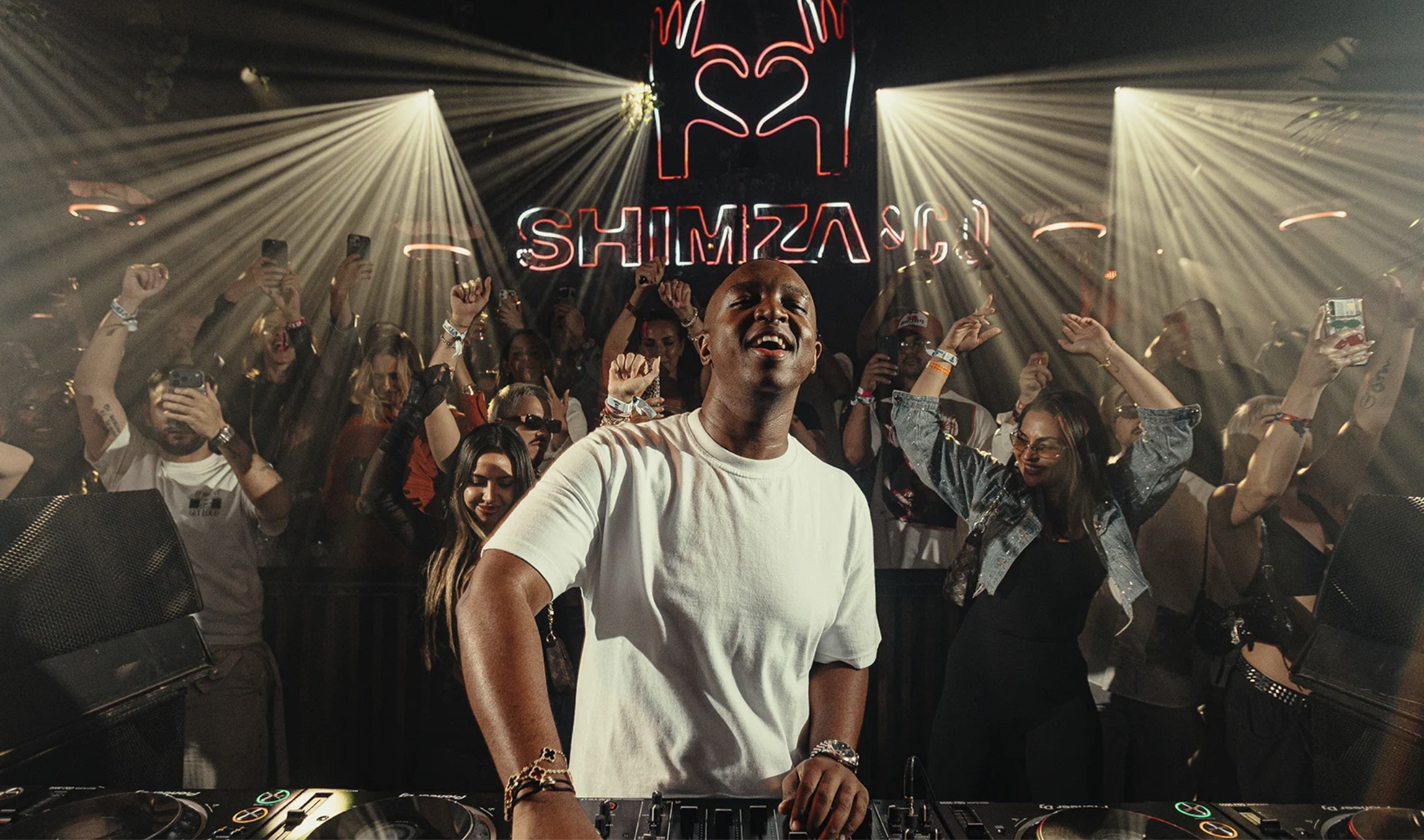
This Christmas Day he spins pulsing Afro-tech and some 3-step — including 2024’s standout ‘Horns In The Sun’ — under a packed-out marquee of thousands. Head high, chin up, he appears more like a conductor than a DJ, coaxing energy from the crowd. “There’s not many DJs that I can see that are looking up at the crowd smiling,” Stay True Sounds label head Kid Fonque tells DJ Mag. “In 90% of the videos, he’s looking directly at the crowd smiling and I’m like, ‘That’s a good flex, man’. A lot of us are in our head — what’s the next tune gonna be? How are we gonna get from this point to that point? Shimz just wants to see what’s going on.”
This highwire showmanship was drilled in early on. Stokvels and braai (barbecue) culture were key incubators for DJs, and every sloppy mix was a chance to get torn apart. Shimza would spend hours practising the basics, drilling transitions until they felt seamless. Sometimes he’d video record these practice sessions to study his mistakes. “I’m happy that I fell into the hands of those guys — Dj Khomza, Mphikzo, Thende, Sizwe — because it was so competitive,” he explains. “Being in that environment helped shape me to be a DJ that wants to perfect their skills, because I would be scared to play a bad mix because those guys would literally have me. It was the best learning because then no one could touch us. It really shaped who I am today, and how specific I am, how I make sure my mixes are tight — selections, beat matching. All of that really matters to me.”
Connection is also a key part of Shimza’s rise. The DJ/producer has been at the forefront of the Afro-tech explosion, fusing the groove and percussion of his (South African) tribal house and Afro-house roots with the driving 4/4 and synth-leaning inclinations further afield. It was this willingness to absorb the musical impulses of different audiences that’s helped him bridge worlds that might otherwise never have met. This desire to connect, to innovate, shows up across his work, from his One Man Show, Kunye and Shimza & Co platforms, right through his back catalogue. Whether producing with South African artists as musically varied as Moonchild Sanelly, Kasango and DJ Maphorisa, or international acts like Louie Vega, James Hype and Elderbrook, Shimza’s ace card is his knack for a visionary collab.

It’s a point that crops up often in our conversation, even in talks about his upbringing in Tembisa. “I used to live across from Tshivenda speaking people, which I didn’t know how to speak, and they didn’t know how to speak Setswana, so we had to find a way to teach each other our languages and find a mutual ground,” he remembers. “It was quite educational for me because then it meant I had an influence of different cultures.” In late July when we first speak, 10 years on from his Ibiza debut and 20 years since he stood outside that house on his way home from school, he’s back on the White Isle preparing to launch his Shimza & Co residency. The month-long event will take over Chinois every Friday in August, with sets from Andrea Oliva, Antdot, Kitty Amor, Dennis Ferrer and more.
What made Shimza a global force was the realisation that he could represent home while still absorbing new sounds. That approach, equal parts pride and curiosity, has led him to some of the biggest stages the world has to offer. “When you’ve been booked by an international promoter as a South African DJ, they want you to play that African sound,” he says when we touch on his early career. “The music I was playing [in the beginning] was inspired by my surroundings, South Africa, where I spent 95% of my time. But if you’re travelling and you’re not learning then you are wasting time. I started travelling to play this African sound to the world, but I started learning how the world was working and seeing how I could incorporate what the world is all about into what I do.”
In the mid-’00s international house sounds were in wide circulation across the country, with House Afrika and Kalawa Jazmee home to some of the biggest house and kwaito artists. Soul Candi, which started out as a record shop in Joburg’s Rosebank neighbourhood, quickly became an additional hub for house music collectors and fans, launching its label wing in 2001. Kid Fonque joined the team around the time a young Shimza was preparing to leave — A&Ring just wasn’t his bag. “He was young, but felt very focused,” Fonque remembers. “I don’t think I’ve met many people with his sort of drive at his age, someone who was that sure of himself. He knew he didn’t want to be at Soul Candi, he wanted to focus on Shimz 100%, and that’s exactly what he did.”
By this time Shimza’s name was everywhere: stokvels, braai joints, club nights, anywhere in Tembisa that had a crowd and a sound system, he’d play. His early mixes leaned deep, soulful and tribal, reflecting the tastes and desired tempo of local audiences, while still displaying the style and technical flair he’d become well-known for. In 2008, he broke out of the township circuit with the Next Big Thing, a televised DJ competition modelled after the Idols shows. The show aired on Channel O, a nationwide music channel, in the search for South Africa’s best up-and-coming selectors. Contestants sent in mixes, the best of which were chosen for training, and finalists spun live on TV ahead of a public vote. Shimza’s TV set juggled acapellas with deep, tech and electro-leaning house. When the SMS votes were tallied, he came out on top. Township DJ battles were a common thing at the time, but the cultural reach of a TV competition was new. “That for me was a big deal, because it was a big achievement for someone that came from a township,” he shares. “People would come together to watch the competition in local parks, and many had celebrations when I won.”
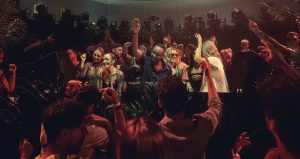
“There’s no opportunity too small. People need to take all opportunities available and see if it will work for them, even if it’s a small needle move. Every opportunity that I was given I took and I ran with it, because I understood that.”
The win launched his name beyond his township, putting him on the radar of promoters across the country and marking his transition from local DJ to nationwide name. “It helped me start touring the country more; I got bookings in and around Gauteng, Durban.” With the bookings, he grew his record collection, bought a car, and started racking up more gigs. In 2009 he staged the first edition of his One Man Show, an event that has since become his defining platform.
Rooted in township culture and staged on Christmas Day — with proceeds funding uniforms for orphaned children, educational programmes, and community development — the first edition was an attempt to grow his name. The plan was simple: book big acts — Oskido, DJ Kent, Black Coffee — to DJ before and after, and continue promoting himself within and beyond the township. “Now I’ve got the financial muscle I could start doing things for myself,” he explains. “The One Man Show was an opportunity to get people from my community that didn’t know about me, that knew about Oskido, to come through.”
2009 was the same year that Shimza met his first production collaborator, Nicholas Mboweni, aka Cuebur. A sound designer and mix engineer by trade, Cuebur had already been producing for years when he heard Shimza playing his track ‘Pepe’ — an underground cut doing the rounds — on METRO FM, the country’s biggest radio station for R&B, hip-hop, kwaito and house music. It was the festival season, December 2008. “I listened and the second to last track he played was ‘Pepe’,” Cuebur tells us over the phone. “He dropped his Facebook and email address so people could get hold of him and I checked him out on Facebook.”
By January 2009 they were sitting in front of a computer at Shimza’s aunt’s house, downloading Reason and mapping out the basics of programming. It was around this time that Cubebur encouraged him to think more seriously about producing, and they started collaborating. “I remember telling him, ‘Yo dude, there will come a point when DJing is saturated — if you make your own music you can go further’.”
The testing ground for their collaborations was Joe’s Butchery, a beloved shisa nyama — or barbecue — spot in the Alexandra township. The space — which is still open — was an outdoor setting, with picnic-style tables and chairs housed under awnings offering a selection of meats off the braai, pap (maize porridge) and chakalaka (a spicy vegetable and bean relish) to accompany the warm and musical atmosphere. Shimza held down a residency there, and every Sunday Cuebur would join him to check the crowd response to tracks the duo had made days — sometimes hours — earlier. “There was something about the crowd,” Cuebur remembers. “You could experiment, come up with something crazy and if they don’t vibe to it, then relax — it’s not gonna work. But if they did vibe to it you knew, OK this has a chance of becoming something huge.”

“There’s so many things you could moan about being South African, so many things, but the one thing you can’t moan about is the music — the music scene here is fucking nuts”. — Kid Fonque, DJ and producer
Their first fully fledged production was ‘Tiba’, a track lost to time, but one which Cuebur remembers making waves. Then came the duo’s remix of Mozambican group 340ml’s ‘I’ll Be Back’, made in Cuebur’s student dorm room. It surfaced in 2011, blowing up on the local music circuit with its warm and pulsing grooves, and was even included on Soul Candi’s ‘Ten Years 2001-2011 – Future’ compilation, signalling its traction in SA house circles. ‘Orujo’, a hard-hitting, percussion-driven track that’s become a classic among Afro-house aficionados, was released two years later. “That was another beast of a song,” Cuebur remembers. “Everyone would play that song — I think it’s because the drums were so infectious, it slapped. It was just chaos, full of energy.”
Shimza was also sharpening his skills at spots like Caprivi, an outdoor club close to his home, as well as continuing to hold the annual One Man Shows. Throughout the years, he kept his DJ chops sharp, practising new tricks for discerning crowds — and this was rubbing off on those around him. “Shimza, at the time, was the only person I knew who was a really technical DJ, working on creative effects — he inspired me a lot with that because he was the only one who was doing that,” Cuebur shares. Having first dibs on upcoming releases didn’t hurt either. “He was also always the guy with the exclusives — he got me a lot of Culoe De Song tracks, Black Coffee. Till this day, Shimza has a golden ear.”
In 2016, Shimza made his Ibiza debut at Destino’s closing party playing alongside Luciano. More bookings followed and he found himself increasingly wedged between tech-house acts, where the pacing and melodic roots differed to the tribal and Afro-house sounds popular back home. Bridging the tempo, percussion and emotion of house music from South Africa with the slick, rolling grooves he was hearing abroad felt like the next logical step. “You travel and you listen to the DJ playing before and after you, and you start discovering the likes of Solomun, Luciano, and you’re in this new world,” he says. “It’s different to where I come from, but I needed to learn some of these elements and incorporate them into what I do.”
Shimza’s musical evolution mirrors the rise of Afro-tech — in large part because he’s been one of its major drivers. The organic, rhythm-focused tracks of his early days have morphed into a more electronic, synth-led sound, bringing bigger audiences to African electronic music as a result. In 2015, when he released debut album ‘Shimuzic’ on Black Coffee’s Soulistic Music label, all the organic elements you’d expect from Afro-house were front and centre, particularly in the first half of the record. ‘Friends With Benefits’, a Cuebur and BK collab from years before, ‘Looking For Love’, ‘All The Way’ and ‘African Woman’ have all the Afro-house hallmarks: soft soulful keys, understated basslines, and complex rhythm sections, with prominent vocals.

Tracks like ‘Nzima’ show just how numinous Shimza productions can be. Sung in Xhosa, a Bantu language, the first verse opens with a question — “Kazi senzeni na?” (what are we doing/what have we done?), a phrase synonymous with a well-known South African anti-apartheid protest song — while the chorus offers a unifying mantra, “Emhlabeni sibuthwel’ ubunzima, Bawo Thixo Somandla” (In this world we carry burdens, Father God almighty). The lyrics, both lament and prayer-like, echo a history and spiritual roots in line with the storytelling nature of Afro-house.
By 2016, Shimza began to signal a shift. The ‘One Man Show’ EP pointed to the past, with remixes of tracks like ‘Friends WIth Benefits’ and ‘Akulalwa’ — also taken from ‘Shimuzic’ — as well as more forward-facing productions like ‘Congo Congo’, which fused synth stabs and African percussion with a tension-release Afro-tech structure. By the late ’10s, he’d hit his stride. His sets and musical production all pointed in the direction of thumping 4/4, the kind that could command the extra-large dancefloors he was now used to playing. The ‘Ascendent’ EP, which dropped in 2017, and 2019’s two-track EP ‘Kings and Queens’, released on Hot Since 82’s Knee Deep In Sound, both leaned further in this direction. 2019’s ‘Eminence’ EP was full of brooding stompers — all heavy basslines and atmospheric stabs, while remaining deeply percussive. He’d finally bridged his drum-led sensibilities with a pulsing tech vision.
“My music is now more aggressive,” he reflects when we ask about the change in his sound, “there’s groove and there’s aggression. There’s also a soulfulness in the music we make. You can feel it.” Producers who know him well say it’s in the details. “He has a way of programming his drums,” Cuebur shares. “There’s some quirks he likes to put in his productions, very subtle things — things that make me think, ‘OK, Shimza touched this’. Little party tricks: remove a kick here, add an extra kick there, do a time-signature change. I can definitely hear he has a hand in it.”
That touch has continued to evolve. From collaborations like ‘Uwrongo’ with Prince Kaybee, Black Motion and Ami Faku, Afro-tech remixes of amapiano hits and James Hype’s ‘Don’t Wake Me Up’, to a stunning reimagining of Angélique Kidjo’s classic ‘Agolo’, Shimza has bridged worlds. In 2023, he reworked Ben E. King’s timeless ‘Stand By Me’, layering Aloe Blacc’s soulful vocals on ‘Darling’, and last year he landed one of his biggest global moments with ‘Places’, a collab with Elderbrook that paired wistful vocals with his trademark Afro-tech groove — the track has clocked in more than 20 million streams at the time of writing.

“There’s no opportunity too small… People need to take all opportunities available and see if it will work for them, even if it’s a small needle move. Every opportunity that I was given I took and I ran with it, because I understood that.” — Shimza
Ear-worm festival-filler ‘Fire Fire’ was this year’s highlight. Where other Afro-tech peers leaned deep, spacious, spiritual, Shimza pushed his sound into a bolder, peak-time space, built for the biggest rooms possible. “You bring it to your world, but you introduce it to this soulful and groovy element so it doesn’t sound too foreign,” he says, describing his balancing between Afro-rooted groove and global electronic textures. “My Afro-tech is more aggressive, it’s got more energy, and I can push to a BPM that works with tech-house DJs. If you play less drums and more melody in the first 30 or 40 minutes, you’ll find your crowd will move to the front. Some will leave, but you’ll find your people.”
The next big step is an album release, a project he’s been wrestling with for a while. Afro-tech, he explains, is changing again and he wants to make sure he’s hitting the mark. “We’re in no man’s land,” he replies when we get talking about the album’s release. “We’re making music that sort of makes sense to South Africa and sort of makes sense to the world — but I think I’ve got my groove with ‘Fire Fire’. It has an African touch, a UK touch with the vocals, and a little Afro-tech with the aggression. I think having that balance, that’s the sweet spot for the album.”
South Africa’s musical landscape has come full circle since Shimza first stepped behind the decks. Once one of house music’s biggest importers, drawing heavily from the deep and soulful styles coming out of the US and UK, in the mid-’10s it began reversing the direction of travel, birthing new genres as well as expanding on the house sound. Artists like Black Coffee, Culoe De Song and Shimza have played a big role in flipping the script — now influencing the global scene, not just borrowing from it. “There’s so many things you could moan about being South African, so many things, but the one thing you can’t moan about is the music — the music scene here is fucking nuts,” says Kid Fonque. “People connect with the records here because they’re really good.” The country has emerged as a key innovator of electronic music, with new sub-genres of homegrown sounds cropping up all the time.
If this wasn’t apparent before 2020, it certainly was after. A few months into the Covid lockdown, Shimza had another brainwave and began reaching out to fellow DJs for a new project. “I was thinking about the way I make a living and how I was going to live when everyone can’t go out. I decided to do a Facebook live [DJing] event with a few friends, and that went viral,” he remembers. “That’s how we got the attention of Channel O — sometimes the biggest opportunities come in times of emergencies.”

Lockdown House Party launched in late March, a televised music event platforming DJs and artists who played live sets from private locations. It became one of South Africa’s most watched shows, turning living rooms into dancefloors across the country. Its fresh, weekly content gave it the edge in a TV programming schedule of repeats.
“Lockdown House Party pretty much changed the landscape for Afro-house, Afro-tech and amapiano just because it existed,” Cape Town-based music journalist Shiba Mazaza tells DJ Mag. “To hear a song drop on the show or to see an artist perform and know that if you hopped onto Twitter or TikTok, people would be talking about it, and it’s all live at the same moment at the same time across the whole country — it was just wild. I don’t think people really realised how much we needed that, this collective embracing of something that belonged to us as a country, that was familiar to us and shared by us all at the same time.” The show pulled from across the electronic spectrum, broadcasting for up to six hours at a time, boosting the profiles of artists like DJ Cleo and DBN Gogo.
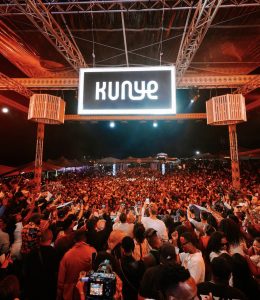
This project gave way to Kunye, Shimza’s most recent party series and record label. Launched in 2020, Kunye was another opportunity to showcase African electronic music under one banner for a global audience. It began life as a live-stream of DJ sets from stunning locations across South Africa and has since become a trusted home for established and emerging Afro-house and Afro-tech artists, such as Thakzin, Bun Xapa, Vanco, Thandi Draai, and Darque. “It’s a platform for us to showcase and export the music to the world in its most authentic way,” Shimza tells us, “to own the narrative and not have our story be told by other people outside of us.” Editions have been held in Nairobi, London and Paris, as well as major cities in South Africa.
Through it all, Shimza’s philosophy has remained simple. “There’s no opportunity too small,” he tells us. “People need to take all opportunities available and see if it will work for them, even if it’s a small needle move. Every opportunity that I was given I took and I ran with it, because I understood that.”
His second album is on the horizon, along with expanded dates for Shimza & Co — including a night at London’s Roundhouse — and a desire to keep connecting with as many people as possible. Cuebur puts it simply, “His hunger hasn’t left him. He’s still persistent and he pushes. To think where he came from and where he is today, it’s inspiring. I remember he used to be the person telling me, ‘Yo dog, we must push if we want this’. He was a man of action, and now it’s paying off.”
Shimza may have mastered the art of DJing, but he’s still listening, still sensitive to the needs of every crowd. The only real difference is that, 20 years on, he’s opened the world up to South Africa, and the world has come home.



Leave A Comment
You must be logged in to post a comment.