
In Los Angeles, a new wave of warehouse parties is reshaping the city’s queer underground nightlife. Presenting a deliberate alternative to the mainstream gay bars and circuit parties where white, cisgender men and commercial interests have historically dominated, gatherings like Signal Underground, Por Detroit and Take It Outside are overcoming prohibitive costs and a lack of club infrastructure to cultivate a scene that’s rooted in a DIY ethos and cutting-edge dance music. Here, Michael Pincus ventures into this burgeoning ecosystem to find out more
We step out of our car at the mouth of an alley near the Santa Monica Freeway, a dozen or so blocks from the Los Angeles Convention Center. Organisers emailed the address just a few hours earlier. Midway down the alley, a group of partygoers in cropped tanks, sagging jorts and Y2K sunglasses huddles around a phone, debating which way to go. Music thumps faintly in both directions. Our groups converge and agree: it’s the left turnoff. We pass two industrial dumpsters covered in dripping graffiti and continue past a pair of utility poles flush against the warehouse wall. A short walk and an ID check later, we’re inside Signal Underground, where the temperature is already climbing, and the next generation of LA’s queer underground is out in force.
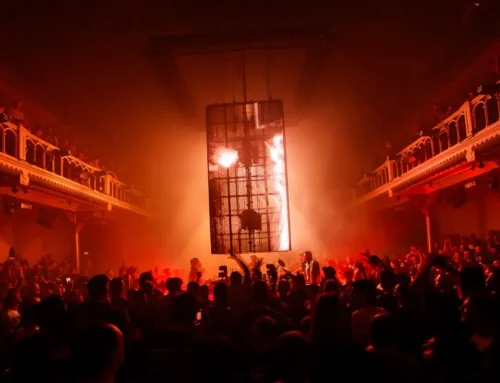
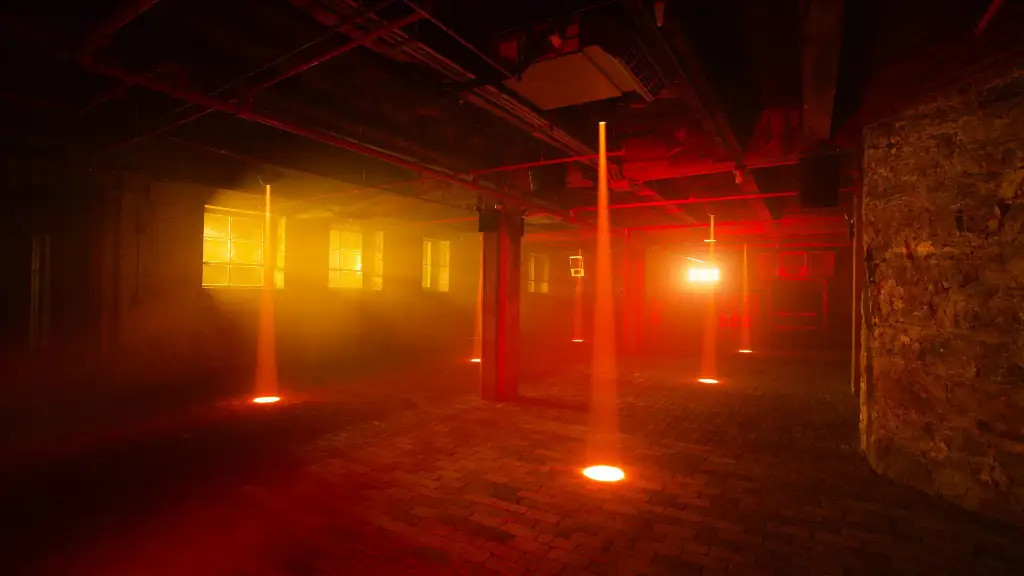
Inside, giant round parachutes billow from the ceiling like soft clouds or the canopies of circus tents. Purple and red lasers filter through their translucent fabric. A disco ball spins over a packed, phone-free dancefloor, where rolling hand percussion and layered polyrhythms propel the crowd. Partygoers chat on cushioned couches like they’re in a friend’s living room. If the alley outside was grim and forbidding, Signal is a warm, technicolour pocket.
We’ve come to see Brooklyn DJ Miss Parker and Loren, a resident at Detroit’s Spot Lite. It’s the first Signal party since the collective’s six-hour takeover of the Beach Stage at Whole Festival in July, the renowned queer gathering held each year outside Berlin.
Across the industrial districts of Los Angeles, parties like Signal are reshaping the city’s queer underground nightlife. From Take it Outside’s femme-forward line-ups to Por Detroit’s spotlight on Latin American artists, these gatherings offer a deliberate alternative to the city’s mainstream gay bars and circuit parties, where white, cisgender men and commercial interests have historically dominated. “I didn’t feel super comfortable or safe at a lot of parties that I was going out to in LA,” says Mez Monty, Signal’s co-founder and first resident DJ. “So when we first started Signal, the intention was very much to create a space that felt inviting and warm.”
“It’s a music-first party — a queer-friendly, music-first party. It’s queer as a mindset, of knowing how to show up in a queer space without making anyone else feel unsafe, or your energy feeling intrusive.” – Mez Monty, Signal Underground
In November 2022, Mez Monty partnered with organiser Andrew Odom and production head Brandon Lloyd to launch a party rooted in classic house sounds. Their experience together at that year’s Honcho Campout, the queer camping festival in Pennsylvania, inspired them to bring a similar ethos to Los Angeles. “It’s a music-first party — a queer-friendly, music-first party,” Mez Monty says. “It’s queer as a mindset, of knowing how to show up in a queer space without making anyone else feel unsafe, or your energy feeling intrusive.”
Music-first values are at the heart of many collectives shaping LA’s post-pandemic queer underground. One is Grotto, an intimate warehouse loft party centred on dub techno, organised by Stewart Randolph (Miracles) and Cory Fisher. “We were thinking specifically of what we’re really into and what we could provide that’s a different experience, [something] that sits in between an experimental or ambient event and a dance event,” says Miracles. “There’s definitely some type of sex appeal to dub techno, because it is a bit slower and it gives, sonically, space to breathe and express movement.” In May, they held Grotto’s first edition at an independent creative space in the Arts District, where Miracles was joined by resident J.dB and local talent Mesmé.
Another intimate loft party, Planet Love, focuses on the harder side of house music and psychedelic sounds. Curated by James Axon, who DJs alongside resident Sergio Rodriguez, Planet Love began in 2022 at Akbar, a historic queer bar, and has since moved underground. “We stand for a specific sound,” James Axon says. “As a promoter, much like with the DJ, you should be presenting a vision of curation. It’s not just who’s biggest. It can’t really be this objective meritocracy either. You have to have a perspective on it.”
Since launching, Planet Love has welcomed guests such as Massimiliano Pagliara, Paramida and OK Williams for extended sets. “It felt like there was something missing: hearing the music I wanted to hear, and also having longer sets, a more mixed audience, a place where I felt like everyone is welcome, and it wasn’t just a meat market or something that was exclusive, or for cool kids or whatever,” James Axon says.
“Our hosts are very important. We always have a host crew for every party, and that really helps us get the word out to specific communities of people we’re looking to reach… They feel celebrated to be there, so they want all of their people to be there, too.” – Miles Powers, Vice Underground
James Axon intentionally left out a dark room. “I’ve been to a lot of dark room-oriented parties, and people are off the dancefloor, just behind a curtain the entire time,” he says. “And then it also just attracts drugs that I think are at odds with dancing, definitely more GHB… We want a space where there’s some idea of emotional connection with people, which includes all types of people, not just those you’d sleep with.”
Signal Underground’s organisers echo that focus on engaged dancefloors. “We want Signal to be music-focused,” Mez Monty says. “It is obviously a queer space. All the producers are queer. But we don’t necessarily try to advertise Signal as a gay party or queer party. The audience that we aim toward is music lovers, and that definitely filters out a lot of riff-raff.” Signal challenges traditional gay nightlife in LA, which often skews toward hookup culture. “You’re coming to Signal to dance,” says Andrew Odom. “In LA, a big cultural monolith that can take over a party is cis gay males seeking a sex-oriented space… After every party, our conversation turns to, ‘How did we feel about the crowd?”
To cultivate dancefloors that reflect the full breadth of queer identity, parties in LA’s burgeoning new scene recruit hosts from various nightlife communities. Typically local creatives or drag performers with ties to specific subcultures, their role is to draw their social circles to the party. One newcomer putting that strategy into practice is Vice Underground, co-founded in January by Miles Powers and Zane Pond (Flabbergast). “Our hosts are very important,” Miles says. “We always have a host crew for every party, and that really helps us get the word out to specific communities of people we’re looking to reach.” Hosting roles also offer paid opportunities and visibility to underrepresented creatives. “They feel celebrated to be there,” he says. “So they want all of their people to be there, too.”
Vice exemplifies a broader shift among LA’s queer parties toward lowering financial barriers. Like many of its peers, the party offers discount codes, flexible ticketing and free admission for trans attendees. “The moment you put a gate up, be prepared for that gate to be broken down,” Miles says. “So make it as easy and accessible as possible.”
“There’s a certain level of innate understanding that you have when you’re in community with your own people, and you don’t have to explain yourself. A lot of the pretence is gone. You can just exist in ways that you may not be able to in other spaces.” – Reed Wadood, AKA Kidd, SXTPS
A departure from cis gay male monoculture is a central tenet of these new parties. In 2022, DJs Heidi Lawden and Masha Mar launched Take it Outside to uplift FLINTA* artists and foster more gender-diverse crowds. “We’re a collective of voices that are not just from a male point of view, or for a male gaze,” Heidi Lawden says. Take it Outside began as an outdoor summer event and now runs year-round, with headliners like Honey Dijon, Avalon Emerson and DJ Minx. “I want the world in my parties and the world in our line-ups to reflect the world we live in,” Heidi Lawden says. “It’s a non-binary world. If our line-ups, back-of-house decision-making and front-of-house dancers don’t reflect the world I live in, then I’m not interested in it.”
Even in a scene that actively resists white cis gay male dominance across its line-ups, crowds and staff, there remains a noticeable gap: relatively few parties are led by trans organisers or by entirely BIPOC teams. Several sources interviewed for this story acknowledge that the high costs and labour demands of producing warehouse events mean those with greater financial privilege — often white cis gay men — are more easily able to take on leadership roles.
Among the exceptions is SXTPS, a party for and by Black and Brown queer and trans people that marked its second anniversary with an event on 22nd November, featuring sets from HUNY XO and Monte Christo. “We are very much here to honour the Black and Brown roots of house and techno,” says SXTPS resident DJ Reed Wadood (Kidd), who co-founded the party alongside Gary Lopez. “There’s a certain level of innate understanding that you have when you’re in community with your own people, and you don’t have to explain yourself. A lot of the pretense is gone. You can just exist in ways that you may not be able to in other spaces.”
Another exception is Trans*cendent, a party organised entirely by a group of four transfemmes committed to building a space by and for their community. As co-founder and resident DJ Kitty Logic recently explained: “It was just four trans girls meeting in downtown, in the middle of nowhere, and talking about, ‘Maybe let’s throw a rave together. Let’s throw a trans rave together.’”
Trans*cendent first took shape as a party among friends in a private basement in Boyle Heights. It has since expanded into a larger, more public event, filling downtown warehouses with trans ravers and their allies. “One of my friends who came told me, ‘This is the most trans people I’ve ever seen in one area in my entire life,’” explained co-founder Lydia. “I know several people who have come to the party, and it is their first time presenting as the gender they are. They chose our party as the space where they could feel safe doing that. It’s such a massive honour.”
“It’s very common these days that everyone puts in a footnote, ‘We do not tolerate any racism or homophobia’. It’s one thing to say that, but it’s a different thing to actually create an authentic safe space… In this day and age, words only go so far.” – Jerren Werbes, AKA Perfect Lovers, Por Detroit
Long-running events like Por Detroit laid crucial groundwork for representation and accessibility. Founded in Mexico City in 2017 by Jerren Werbes (Perfect Lovers) and Arturo Mejía (Kodemul), the party expanded to Los Angeles in February 2019, where it has developed its own identity. Known for spotlighting Latin American DJs, Por Detroit attracts one of the most diverse crowds in the city’s underground. “There’s so much amazing talent in the Latin community, both in LA and in Latin America, that just gets completely ignored because the scene is so Euro- and American-centric,” says Perfect Lovers.
Por Detroit includes a $1 to $2 mutual aid fee on every ticket to fund microgrants for those in need within their community, including trans people, immigrants and those affected by ICE raids. The crew also raised more than $40,000 on GoFundMe for Rosy’s Tacos, a beloved food vendor in the LA queer scene that was facing financial hardship. “It’s very common these days that everyone puts in a footnote, ‘We do not tolerate any racism or homophobia,’” Perfect Lovers says. “It’s one thing to say that, but it’s a different thing to actually create an authentic safe space… In this day and age, words only go so far.”
Perfect Lovers’ husband, Victor Rodriguez, is part of the team behind Ostbahnhof, another queer party in LA that predates the pandemic. Their recent “Area 69” alien-themed Halloween rave drew one of their biggest and most elaborately costumed crowds to date. “LA is a small scene, and we all know each other,” Rodriguez says. “It’s also very supportive. All the kids I know literally go to every party. Even if there are three in a night, they’ll hit all three.” To him, that closeness is what gives the scene its character. “It’s like being at a house party,” he says. “It’s a lot of familiar faces; it’s basically the queer Cheers.”
This isn’t the first wave of queer underground parties Victor Rodriguez has seen. Before Ostbahnhof, he co-founded Shits & Giggles in 2008 with Chris Bowen, now his DJ partner in Bears In Space. “I think that things ebb and flow,” he says. “In my time doing this, there have been explosions of fresh, new energy. It happened in the mid-’80s, and again 20 years ago, when there were a lot of really amazing parties happening, during the time of Shits & Giggles.”
Alongside Spotlight, the defining warehouse party launched by Chris Cruse in 2012, Shits & Giggles helped shape the last major renaissance in LA’s queer nightlife. “Now and historically, when times have been really dark, nightlife tends to explode,” Victor Rodriguez says. “People need to have that sort of escape and find their family. And I think there’s probably a lot of that going on right now.”
“The difference between LA queer nightlife versus elsewhere is that we don’t have the venues, so it’s all DIY. It’s so labour-intensive to organise one of these events… It just feels much easier elsewhere, and it’s harder here, but that also makes it perhaps more special.” – Masha Mar, Take it Outside
Unlike cities such as Berlin, New York and London, where permanent venues offer a diverse spread of weekly programming catering to all tastes and subcultures, LA’s DIY queer scene operates without a stable club infrastructure. California law prohibits alcohol sales between 2 and 6AM, pushing parties further underground. Many unfold in warehouses where organisers load in and out within 24 hours. That intensity makes it difficult for any one party to happen on a weekly basis. Many recur monthly or quarterly, which allows a wider range of parties to flourish without a single venue or promoter dominating the scene.
“The difference between LA queer nightlife versus elsewhere is that we don’t have the venues, so it’s all DIY,” says Masha Mar, co-founder of Take it Outside. “It’s so labour-intensive to organise one of these events. We don’t do them that often because we really give it our all.” The financial burden of building everything from scratch adds another hurdle. “It’s so cost-prohibitive to rent a sound system for a day and hire labour and staffing,” she says. “It just feels much easier elsewhere, and it’s harder here, but that also makes it perhaps more special.”
Mez Monty of Signal Underground agrees. “We can step into a bit more of a fantasy and create something very ephemeral that is literally built up and torn down within 24 hours,” he says. Signal builds its setup in a studio off-site and installs everything the day of the party. “We just want to set a higher standard in LA,” Mez Monty says. “It’s the second-biggest city in the country, and there’s no reason that we can’t have an amazing nightlife space just like New York. We don’t have the same infrastructure, but in a lot of ways, having an underground space is really awesome because you just have so much more control over the experience in the space.”
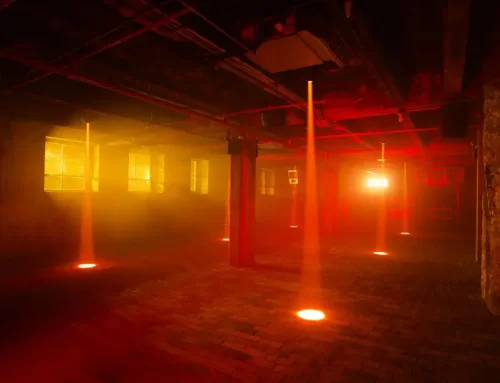
That freedom has allowed Signal to transform bare concrete warehouses into radiant, welcoming environments. Each edition brings new sensory touches: the jellyfish-like parachutes drifting overhead, custom aroma scent-scaping, backlit lightboxes with dancers inside casting striking silhouettes, and fresh orange slices passed out to ravers during the final hour. These details help soften the industrial setting, reflecting the joyful spirit of the house music at the party’s core.
For Mez Monty and others, the opportunity to create these spaces comes with a sense of personal responsibility. “We really do set an intention to bring people together to facilitate connections that maybe wouldn’t have been facilitated before,” he says. “Music is a healing force. And it feels increasingly important to hold these spaces. I mean, this is my life’s work. This is how I contribute to society.”

Leave A Comment
You must be logged in to post a comment.