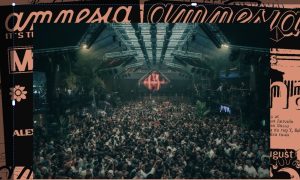
Fabled Ibiza club Amnesia reaches its 50th birthday milestone this year. A pivotal nightspot in the explosion of electronic music worldwide, it was the catalyst for the Balearic sound pioneered by the late Alfredo and pal Leo Mas. Amnesia continued to develop through the late ’80s, ’90s and noughties, becoming a crucial rave home for techno, progressive and trance sounds, continually morphing and developing from season to season, and bringing through all manner of dance stars who we now love and cherish. To mark its 50th anniversary this season, Kristan J Caryl talks to former residents such as Sven Väth and others for whom Amnesia has been hugely influential
The white, centuries-old finca that became legendary Ibiza nightclub Amnesia first opened for dancing in 1976. All the things that made the rural farmhouse one of the best clubs in the world less than a decade later had already long existed in Ibiza: carefree dancers, colourful fashions, eclectic crowds and psychoactive drugs. All that was missing was a Balearic beat. As far back as the 1960s, word about this sun-baked island paradise and its turquoise waters had got out. Tourism had hit. Franco’s fascist regime was losing its grip on Spain, and the bustling Las Dalias flea-market became an early hub of free-thinkers and fun-seekers. It’s where a night of live flamenco, sangria and champagne set people back 125 pesetas, roughly equivalent to £1 at the time.
The next decade brought an endless influx of outsiders, including Vietnam draft-dodgers and those fleeing political repression from countries such as Argentina. Amnesia’s foundational resident and Balearic beat godfather, Alfredo Fiorito, was one of many who fled Argentina following the military coup in 1976.
He arrived in Ibiza in 1976 with no plan other than to sustain himself with bar work. That same year, Madrid-born philosopher Antonio Escohotado had leased the now-iconic Amnesia building from an aristocratic widow. He initially opened it as El taller del olvido or The Workshop of Forgetfulness — a sanctuary for idealists to dance to hippie bands and escape the ordinary. Entry, including a beer, was 25 pesetas. Parties in the open courtyard often ran into the following afternoon, with non-stop dancing around the small central water pool — built over the old finca’s water well — crowned by a glass pyramid.
Over the years, owners and musical trends came and went. As the 1980s began, bands were out, and the dance music of the time was the principal soundtrack. By then, Alfredo had graduated from serving drinks to playing records in local bars. He was given his first Amnesia gig in 1983 and played under the trees that still stand, on the open-air dancefloor that is now covered. Often in a symbolic Che Guevara beret, the Argentinian harnessed the energy of the rising sun in a way that amplified the music and moved people differently.

“It was everything the UK scene was not. Music was very tribal back in the ’80s. We danced to Black music. Rare groove, Northern soul, house, early techno.” — Terry Farley
A newly eclectic mix of everything from U2 to The Woodentops, Prince, Barry White, Joe Smooth and ‘The Pink Panther Theme’ all made sense through Alfredo’s hands. Balearic beat was born, and Amnesia mornings quickly became the place to be for a swirl of characters of all ages and backgrounds: not just the hippies and the locals, but the super-rich off their yachts, discerning Brits who strayed from the beer-soaked, lobster-red Club 18-30s crowd in town, and plenty in between.
“It was everything the UK scene was not,” says Terry Farley, who went to the 1989 opening party, which was Boy George’s birthday. “Music was very tribal back in the ’80s. We danced to Black music. Rare groove, Northern soul, house, early techno.” To Terry, the idea of flying to Spain to hear Latin, pop and rock felt faintly absurd. “Within about an hour, you kind of got the idea,” Farley laughs. “When Alfredo played Mandy Smith [probably the ‘Cool & Breezy Jazz Mix’ of ‘I Just Can’t wait’], it was just like, yeah, I understand it now.”
It was not just the records that worked, but the whole contextual cocktail. “A bloke was walking around with a sort of crop-sprayer’s backpack on, shooting what they called ‘coca loco’ into everyone’s mouths,” recalls Terry. That mix of cola and MDMA oiled the party while aristocratic Italians and South London kids in flower power garb danced next to Formula One driver James Hunt, “completely off his nut”. There was no real production other than what nature provided with the sun and the stars.
“That summer, Alfredo ended every night with the theme from Hill Street Blues, and he would be playing these records two or three times in a set.” Terry credits Nancy Noise as the connection to Alfredo’s record box. “For the whole of that season, she stood to the side of Alfredo, looking over, trying to identify everything. She was the one Oakenfold would ask, ‘What’s that record Alfredo played?’ If you told me the year before that I was gonna be playing Cyndi Lauper and everyone would be going crazy, I’d have thought you were mad, but that’s the impact Alfredo and Amnesia had.”

By the time of Terry’s visits, Oakenfold and fellow Brit DJs like Danny Rampling, Nicky Holloway and Trevor Fung had already made their much mythologised trip to the Balearic island. The subsequent London parties such as Shoom and Spectrum were essentially Amnesia spin-offs that famously helped usher in the so-called Second Summer Of Love in the capital and beyond. Without that influential Ibizan spark, who knows how differently the UK club scene might have evolved.
Though he gets less of the spotlight, Terry Farley credits Sardinian Leo Mas and Cesar de Melero with just as much influence in those early Amnesia years. Leo Mas had become great friends with Alfredo after being introduced by a mutual acquaintance and connecting over mixtapes. “We played with complete freedom,” he says. “We weren’t two classic DJs who had to please the dancefloor at all costs. We were anarchic and rebellious music lovers who played for unconventional people — hippies, gays, pop stars, drug dealers, workers, directors, creatives.”
The records they played came from all over Europe, with many unearthed on digging trips to Milan. It was music without borders, but Mas sensed something “revolutionary” was happening in the ’87 season. “I call it Year Zero,” he says of the summer he and Alfredo decided to play much more house music from Chicago, Detroit and New York City. “We didn’t feel very hedonistic. Part of the audience who came from Pacha or Ku was, but we weren’t. We liked to go against the grain.” But then came ecstasy. “E and house were an explosive mix that, together with Ibiza’s way of living day and night, changed the club world forever, first in the UK, then across the world. People had their hands in the air while we were playing The House Master Boyz & The Rude Boy Of House. I felt that we were all on the same frequency and that the music was uniting us as one family.”
In 1991, Martin Ferrer acquired Amnesia. He already owned a club on the Spanish mainland, but didn’t move his family, including his son Mar-T, over for another decade. Martin Jr was aware of the legend through classmates at his British school, but “the first time I walked in for a Cream party was a double impact,” he tells DJ Mag. “What impressed me the most were the ceilings in the Main Room made of sabina wood. It felt like a fusion between electronic music and being inside a traditional Ibizan farmhouse. That contrast was powerful.”

“We don’t feel we have some kind of divine mission to preserve the island’s spirit. It’s simply a reflection of who we are, what we’ve learned and what we like. We are what we are, for better or worse.” – Mar-T, CEO and artistic director at Amnesia
Mar-T is now Amnesia’s CEO and artistic director, and has been a resident DJ since 1999. “The essential thing was that it had to be a profitable business,” he says of the work his father did once he took over. “Free parties had no future. The 1970s are very far from the world we live in today. Balearic spirit is special, yes, but only if it’s sustainable. We enjoyed the process, and I think that’s something the industry has lost: if what you do excites you, that energy is transmitted.”
Along with the rest of the team, Mar-T is involved with curating Amnesia’s soundtrack every year. “We don’t feel we have some kind of divine mission to preserve the island’s spirit,” he says. “It’s simply a reflection of who we are, what we’ve learned and what we like. We are what we are, for better or worse.
“The secret to Amnesia’s longevity is that it has always adapted to the times. It has always been able to take the best from each era and listen to the fans, especially when they offer constructive criticism. There has always been respect for the artists who have been part of our journey and helped shape what we are today. I don’t think we’ve done too badly if we’re still here after 50 years at the forefront.”
By then, another definitive chapter for Amnesia — and Ibiza — had already started: Sven Väth’s techno-centric Cocoon party on Mondays began in 1999. Sven had first visited in the ’80s as a teenager. “There were people with percussion instruments drumming… the smell of patchouli and good hash in the air,” he remembers. “It felt like a ritual. That energy shaped me deeply, so when Cocoon found its home at Amnesia, it wasn’t random. For me, the club represented origin, freedom and transformation. I knew its history not as a historian, but as someone who lived it on the dancefloor.”

It was Mar-T who first broached the rather risky idea of a residency, despite techno having no audience in Ibiza. “I told him very clearly,” says Sven, “if I do this, it has to come from conviction and from the heart. Ibiza had given me so much that if I returned, it would be to give something back.” Four test events went well, despite the spectacle of Manumission at neighbouring Privilege being the big Monday draw. “I was never interested in competition,” Sven explains. “I wasn’t trying to fight something. I wanted to build something of my own with my vision, my artists, my crowd.”
For 19 summer seasons after that, Cocoon at Amnesia was the only place to be on a Monday. The first years were “financially tough” and “swallowed a lot of money”, but step by step, something special grew. Sven played the Main Room, Ricardo Villalobos was the Terrace resident, Richie Hawtin was a regular, and a colourful brand of techno became a part of Ibiza’s musical DNA.
“Playing there was always intense,” says Sven of the parties, which had wild production but wilder crowds. “In the morning, the sunlight would slowly push through the transparent roof. That moment when darkness meets the first daylight was pure magic. The sound system had power, but what made it special was not only technical. It was the collective energy. People from everywhere — Brazil, Germany, the UK, Italy, all meeting on one floor, sweating together.” Those Cocoon years still mean a lot to Sven. “Today I can choose where and when I play. There are many promoters, many concepts, many nights trying to be special, but what we built at Amnesia wasn’t marketing. It was a belief.”
When Neil Evans first walked into Amnesia in 1999, he was in awe. Cream was in full force. Deep Dish and Hernan Cattaneo were on the bill. He can’t remember much else from that night, but he knows he arrived because of the stories of Alfredo and the tales of that first wave of British DJs who carried something ineffable back to the UK. A quarter of a century later, he is starting his 10th year as the club’s musical director. Neil’s initial brief was not to rip up the blueprint, nor to lean lazily on the past. Music On had departed, Paradise was incoming, and new residencies were forming. “There wasn’t really a specification,” he recalls. “It was just about evolving authentically.” That evolution has meant not chasing whatever is momentarily fashionable. “We’re not a commercial club,” he says plainly. “If you come to Ibiza, you kind of see the same thing everywhere, every night. We try to push the usual island boundaries a little bit.”
That ethos runs in particular through in-house night Pyramid, the ambitious flagship where he and the team stretch from minimal to tech-house to harder techno, live shows and out-of-the-ordinary artist pairings like Chris Stussy and Ricardo Villalobos. It is less about obvious combinations and more about context — about exposing DJs to different rooms and audiences.

“If we do too much, we won’t retain the authenticity. Amnesia is, at heart, a heads-down club. Production matters, but it’s the music that leads, we don’t want big showy LED screens — we’re not that sort of place.” – Neil Evans, musical director at Amnesia
A development philosophy is central these days: rather than always parachuting in headliners, Amnesia seeks to grow artists over time. Evans points to NEXUP’s Max Dean and You&Me’s Josh Baker, who started on smaller bills before rising to full residencies in 2026. Both have told him they once stood wide-eyed on the dancefloor and dreamt of playing the legendary booth. In recent years, there have also been Ibiza debuts for Boiler Room, adventurous-for-Ibiza shows with Bonobo and Overmono, Do Not Sleep, and platforms for new school favourites like East End Dubs. Marco Carola and Joseph Capriati might now be two of the biggest draws on the island, but it was Amnesia who took a chance on them early in their careers.
Behind the scenes there is always change, but subtly so. A replacement Terrace roof has been installed, comprehensive soundproofing has been added to meet the latest noise legislation, and the sound system is constantly refined by George Stavro, a 40-year industry veteran who’s worked on some of the world’s most celebrated systems. Much of the work is invisible to the casual observer, but that’s the point. “If we do too much, we won’t retain the authenticity,” Evans explains. “Amnesia is, at heart, a heads-down club. Production matters, but it’s the music that leads, we don’t want big showy LED screens — we’re not that sort of place.”
The 50th year will be marked with special one-offs, including Cocoon, a show from electronic pioneer Jean-Michel Jarre, and a Haçienda Classics celebration, while glam bonanza Glitterbox arrives for the first time, and Joseph Capriati’s Metamorfosi returns. Then there’s techno from Resistance every Wednesday, whose residents include Drumcode man Adam Beyer, ARTBAT, Boris Brejcha and Eric Prydz, plus harder underground sounds from disruptive Manchester crew Teletech and plenty more. The Opening Party on May 9th boasted Ceri, Enzo Siragusa, Fleur Shore, Josh Baker, Luke Dean, Mar-T, Marco Faraone, Max Dean, Seth Troxler, Alan Fitzpatrick, Amelie Lens, Fatima Hajji and lots more, while the team are reportedly already cooking up multiple surprises for the Closing Party at the end of the season.
Amnesia has never been about chasing the scene, but creating its own. What began in 1976 as a sanctuary for outsiders became the crucible for Balearic beat, the catalyst for Britain’s acid house explosion and a keystone in Ibiza’s mythology. Alfredo and Leo’s sunrise eclecticism, the lawless freedom of those early mornings and the chain reaction that led to the Second Summer Of Love were not calculated business moves. They were accidents of chemistry and timing: the right records, the right people, the right island.
Half a century on, the setting has evolved, but the principle remains intact. Spectacle is resisted, DJs are trusted to take risks, and the stretch of night into morning is where the magic happens. Though once known as The Workshop of Forgetfulness, the role Amnesia has played in shaping dance music history will be remembered forever.





Leave A Comment
You must be logged in to post a comment.