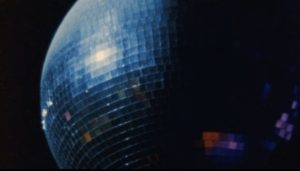
More than a century old and ubiquitous as ever, the mirrorball dates as far back as the 1890s. Embraced by jazz clubs in the 1920s before becoming the iconic symbol of ’70s disco, it continues to light up dancefloors like few other objects can, shining on in myriad ways and finding itself at home in the most unlikely of places. Here, Marke Bischke takes us on a twirl through the ever-evolving – and revolving – story of the disco ball
Guy Pritchkin, a young raver in a puffy orange vest, backwards baseball cap, and oversized yellow sunglasses rides a San Francisco train at the turn of the century. He’s on his way to set up an after-hours party in some far-flung corner of the city. In his lap: a ridiculously large disco ball, which he can barely wrap his arms around. He grins and nods slightly as if to say, “Look, you just can’t have a massive without it.”
This iconic moment in the 2000 movie Groove — one of the few relatively cringe-free representations of the millennial party scene — was instantly immortalized as what would have passed for a meme in pre- social media days. “I saw it wheat-pasted all over every major city in America,” local DJ and producer Dmitri Ponce tells DJ Mag on playing Pritchkin.
“People have dressed as the character for Halloween and sent me photos. I got into [round-the-clock SF dance palace] the End Up for free for 20 years because of that. I think I’m permanently, spiritually linked with the disco ball now.” It’s one story of how the mirrorball endures as an avatar of dance music authenticity, a perpetual symbol of what Ponce calls a “true international House Nation, not about commercial music and streaming numbers… The real underground, the disco ball reflects that”.

While some consider it a musty relic of the 1970s disco era, the coruscant orb still fascinates, raining showers of light onto revellers at cutting-edge clubs where it’s proudly featured, from Phonox in London to Refuge in New York and beyond. Even as the world — and lighting technology — turned digital, the radiant archetype shined on in surprising ways. Record-breaking civic monuments, cheeky emojis, flashy clothing and home decor, scintillating dirigibles hovering over the Burning Man desert — even Madonna hopping out of a giant one onstage — the mirrorball’s hypnotic flicker continues to draw dancers to the floor well into the 21st century.

A flash through the mirrorball’s century-plus history reveals roots much deeper than polyester pant suits and platform heels. A 1897 edition of the Massachusetts Electrical Worker periodical contains its first recorded use, in a spectacular light show at an electrician’s ball, which could be seen for miles around Boston.
In 1916, US inventor Louis Bernard Woeste filed a patent for the “myriad reflector” made up of “mirrors mounted to a polyhedron bounded by a complex system of plane faces.” His Cincinnati firm Stephens & Woeste sold them throughout the 1920s, promising to enchant dancehalls with “dancing fireflies of a thousand hues”. Jazz clubs embraced the brilliant effect: one of the first photographic depictions of a mirrorball is a 1919 snap of the Dixieland jazz band Louisiana Five. The hyperkinetic 1927 German silent film Berlin: Symphony Of A Metropolis also features one in a nightclub montage.
America’s Great Depression put a damper on sales, but things picked up again in the 1940s. US furniture manufacturer Omega National adapted its uniquely flexible mirrored sheeting — used to create flamboyant pianist Liberace’s famed glass grand piano, to wrap around spherical bases — due to growing demand from jukebox joints, dancehalls, and amusement parks.
According to drinks culture website VinePair, soon 25 Omega workers — the majority of whom were women, due to the World War II draft — were producing approximately 25 mirrorballs per day: “The shimmering trinkets ranged from two inches in diameter to as large as six feet, with the average price of a 48-inch ball amounting to $4,000 — just about $20,000 in today’s dollars.” Omega National was pumping out 90% of the world’s mirrorballs at its height, and continues to this day under the auspices of master disco ball maker Yolanda Baker, scoring high-powered commissions from Madonna, Beyoncé, and long-standing US TV series Dancing With The Stars.
In the 1960s things got trippy, as they should. Pop Artist Andy Warhol’s psychedelic, multimedia “happenings” — called the Exploding Plastic Inevitable — plunged live shows by seminal art rock band the Velvet Underground into a hallucinogenic maelstrom. Massively enlarging the vocabulary of concert lighting, the shows enlisted mirrorballs for experimental “lightworks” configurations, alongside manually synchronised colour effects, slide shows, film projections, moving screens, and iridescent curtains of light.

“I’ve witnessed first-hand over the years how quickly lighting technology has moved on, but this has just meant the market for mirrorballs has got bigger. Even with the competition of LED walls, they are unbeatable for lighting large spaces and bringing people together.” – Mirrorball Paul
Then disco dawned, dappling dancefloors with underground energy as Black, Brown, and queer people built a utopia apart from a world that gave them no room to dance. Disco balls, as they were now called, were suspended in New York City spaces like David Mancuso’s Loft and Nicky Siano’s Gallery. Denizens of DJ Larry Levan’s Paradise Garage were also summoned to heed the call of the ball. The queens of San Francisco’s debaucherous queer party central Trocadero Transfer, where frenetic tempos and lightning-fast hookups birthed the synth-driven Hi-NRG movement, went one, or rather several, better. The club’s centerpiece was an outrageous cluster, containing almost a dozen disco balls in one contraption, hung on motorized arms which rotated the whole shebang in several directions at once.
The apex of the mirrorball’s pop culture presence came with disco’s mainstream moment, in blockbuster ’70s films like Saturday Night Fever and its darker twin Looking for Mr. Goodbar. When disco was reborn as house and techno, and as other analogue club accouterments succumbed to digital replacements, the mirrorball often remained in the mix.

“I’ve witnessed first-hand over the years how quickly lighting technology has moved on, but this has just meant the market for mirrorballs has got bigger,” artisanal sphere-crafter Mirrorball Paul tells DJ Mag. “Even with the competition of LED walls, they are unbeatable for lighting large spaces and bringing people together.”
Nowadays, you can decorate your own loft with a Dali-esque melting mirrorball by design-art collective Rotganzen, clip a little glitter ball on your knapsack next to a grinning Labubu, or even step into a Yayoi Kusama Infinity Mirror Room in a major museum to feel like you’re living inside one. The ever-evolving — and revolving — mirrorball saga is still taking some remarkable turns.

Perhaps the biggest evangelist of innovative mirrorball designs is Mirrorball Paul himself, a prop hire specialist who’s been designing glittered spheres for more than two decades. On a trip to Scotland for a TV gameshow production, he popped into the Barras market in Glasgow and chanced upon an enormous specimen, which turned out to be a relic of the nearby Plaza Ballroom, a rave hot spot in the 1990s.
“The stall owner told me he had sold it five times before, but no one could get it through their doorway. We did a deal, and I strapped it to the roof of my Astra. He parted the crowds for my car to leave, shouting, ‘See the last part of the Plaza go!’ I later came to the conclusion that the ball’s beautiful tarnishing had probably been brought on by ‘rave sweat’. I repaired it a little and drove it down to London, which drew quite a few waves on the motorway.”
The ball caught the eye of his neighbours next to his prop shop, and they asked Paul to rig it up for their new series of soon-to-be-infamous London parties, Secretsundaze. “I took a ‘Heath Robinson’ approach to making the ball spin slowly — which is the key — and used Optikinetics Projectors to light it,” he says. “Seeing the ball at those early parties, I became struck by how it brought something unifying. During the summer months as the sun set, the mirrorball would come into its own, glinting at dusk over the rooftops. When I took the ball down, it would become surrounded by day-ravers, who would crowd round and try to touch it. I loved it. So I decided to make some more.”

And more he’s made: gold balls, pink balls, mosaic balls, balls that radiate triangular beams (“they take a lot of maths!”), even “Monir balls” inspired by the work of Iranian contemporary artist Monir Shahroudy — composed of thin rectangles of coloured glass that create a spiral effect when they spin. “I’ve mirrored monkeys and mopeds,” Paul adds, without elaborating. Through it all, he’s honed ingenious engineering and transport solutions as a DIY operator at impermanent affairs. A bike mechanic friend helped him figure out how to rotate balls with the low voltage available at many outdoor raves, and later to house battery powered, remote controlled lasers inside them, projecting 360-degree tunnels and shapes from small holes.
One key aspect of his craft? Pace. “Different speeds means the balls can adapt to different styles and you can break away from disco,” he explains. “Slow beams create a more atmospheric effect, used by artists such as Adele and David Gilmour; at the other end, we can apply the drive systems and DMX control to more experimental designs used by the likes of the Chemical Brothers and Radiohead.”
During Covid, when business slowed precipitously, Paul brought cheer to many, illuminating Epping Forest and other historical sites with free-standing mirrorballs. “We experimented with mirroring large parabolic dishes, which nearly resulted in me burning my garden shed down when I left one in the sun!”

The current Guinness World Record-holder for Largest Disco Ball is a 10.33-metre-diameter inflatable whopper that made its debut at Bestival 2014. It was manufactured by creative firm Newsubstance after disco legend Nile Rodgers dared the Isle of Wight festival’s co-founder Rob da Bank to deliver — as da Bank put it — “something spectacular” for Chic’s appearance at its Desert Island Disco edition.
While not an official record challenger, and more a reflective zeppelin than a true mirrorball, Bjarke Ingels and Jakob Lange’s roughly 25-metre-diameter inflatable art installation ‘The ORB’ bested the Bestival sphere when it debuted at Burning Man in 2018. Described as a “mirror for Earth lovers” at a scale of 1:500,000 of the planet, the ORB was fashioned from the same chromatic fabric as NASA weather balloons and required approximately 1,000 hours of welding and an additional 1,500 hours of sewing to hover over ecstatic, dust-streaked Burners. But before either of those airy behemoths claimed the crown, a far more down-to-earth and poetic art project held the Largest Disco Ball title.
In 2000, a meticulously hand-fashioned mirrorball rose above the Blackpool waterfront promenade in the North of England, reflecting the Victorian- era seaside resort’s complex history as a nexus of working-class entertainment and storied nightlife. Measuring six metres in diameter, weighing six tonnes, and containing 45,000 pieces of glass, They Shoot Horses, Don’t They? was a public project submitted by young artist Michael Trainor during the turn-of-the-century “visitor economy” monument-building trend — which also yielded sculptor Antony Gormley’s Angel of the North in Gateshead and the London Eye Ferris wheel.
“It was my first big proposal, and it turned out the council had some money for it — so then I had to figure out how to build it,” Trainor tells DJ Mag. The idea had been born partly from visits to the site, bordered on one side by the violently turbulent Irish Sea and on the other by the famous Blackpool Illuminations — a frenetic near-six-mile-long electric light show dating back to 1879. “What could compete with such things?” he asked himself.

“I was driving by with my fellow artist friend Liam Curtin, talking about how I was looking for something to wrap up around this environment and all this wild history. He suggested a mirrorball, and I thought, yes, that’s it, exactly. Quite large, too.” – Michael Trainor
Trainor also wanted to capture the shifting economic and cultural status of a place that loomed large in the popular psyche. From the late 18th and well into the 20th century, northern industrial towns would shut down for an entire week so workers could take a holiday — Blackpool was one of few affordable options. Its vast antique ballrooms weathered boom and bust, hosting ’70s Northern soul nights, DJs that would push the UK’s ’80s modern soul movement, and with Manchester close by, underground rave nights well into the ’90s.
But by the turn of the century, the growing popularity of budget airline flights to sunnier party spots, like Ibiza and Benidorm, was once again darkening Blackpool’s holiday prospects. “I was driving by with my fellow artist friend Liam Curtin, talking about how I was looking for something to wrap up around this environment and all this wild history,” Trainor explains. “He suggested a mirrorball, and I thought, yes, that’s it, exactly. Quite large, too.”
With its name pinched from the tragic 1969 Jane Fonda film about a group of Depression-era strivers desperate to win the cash prize at a dance marathon, the ball was on. He lucked upon a structural engineering firm game to produce the project, while one of the world’s leading makeup compact manufacturers took on the task of fashioning the specially-designed mirrors and a host of community volunteers helped affix them.
‘They Shoot Horses’ soon became an emblem of both the Northern UK and post-millennial rave culture, its likeness used in BBC News idents and on underground party digital invites alike. (Ironically, Trainor was no techno fan, having run an art stall in a market across from a record shop that played the latest Haçienda tapes all day long.)
The monument has been refurbished twice — once in 2010 with Trainor’s full participation, and then during Covid, as a volunteer-led civic project. “I never need to go to Blackpool again and glue 45,000 mirrors onto a giant sphere,” the artist says lightly, but with a deadly serious look in his eye. He’s since moved on to other big projects anyway, designing what he calls “The Last Art Show” — a suite of post-apocalyptic artworks that come into being when triggered by nuclear explosions.

In 2017, Gero Simone, a host at the German youth radio station 1LIVE, casually asked his listeners what new emojis they would love to see. The most popular answers intrigued him: DJ, mirrorball, seal (as in the animal), and “idiot”. “I loved the excitement around the ideas, and then I found out that anyone can apply for a new emoji,” he tells DJ Mag. “So I said, ‘Why not?’, and leapt down the rabbit hole. But I was a bit naive.”
If the prospect of constructing a gargantuan mirrorball in real life seems daunting, getting a tiny virtual disco ball onto phone screens also comes with its own challenges. The international non-profit organisation in charge of signing off on new emojis, the Unicode Consortium, is indeed democratic in welcoming proposals. But the process itself is rigorous and requires an accumulation of information and data that was beyond Simone’s sphere. But he persevered, even seeking an audience with the “Emoji Pope” — Jeremy Burge, founder of Emojipedia and World Emoji Day — who encouraged him to push onward.
Eventually Simone connected with Emojination, the grassroots group founded by emoji guru Jennifer 8. Lee that advocates for new and culturally inclusive emojis. Lee convinced him that the mirrorball option would be the least problematic pursuit (“forget the idiot”) and paired him with Theo Schear, a filmmaker and nightlife writer who created the juice box and harp emojis, to help build out the proposal.
“There was so much evidence that the mirrorball was one of the most requested emojis on Twitter and other platforms,” Simone said. “It was still a big part of popular culture, with Lady Gaga and Katy Perry wearing disco ball outfits, and nightlife this very global thing. Plus, I’m in Germany, where clubs are rather important,” he laughs.
One of the winning aspects of the mirrorball emoji project was the non-gendered nature of the object itself. The only existing symbols for nightlife, the official proposal pointed out, were a male-presenting dancer and a female-presenting dancer, both in stereotypical stances and outfits. The mirrorball emoji transcended this binary, representing a multitude of situations and people. “Disco is the music genre of queer people, so we needed to have something non-gendered to represent it. It felt really important.”
Simone created a specific radio segment called “Emoji Update” that kept listeners informed of every step of his mirrorball journey. After four years, the symbol was finally approved and became universally available. “So many people use it for so many different things, even some I don’t understand. It’s great,” he shares, now known as “Der Erfinder des Discokugel Emojis” (The Inventor of Disco Ball Emojis). “I would probably never do it again, but to see this joyful thing every day is very cool. I can’t imagine anywhere you go for partying that doesn’t have a disco ball, now even on your phone.”

“Even though my pieces are for your home, just like when the light hits a mirrorball in a club, when sunlight hits a piece it totally changes the vibe of the room you’re in. It brightens everything up and brings that energy into your life.” – Sofie Berarducci
Another mirrorball advocate stretching the sphere beyond the edge of the dancefloor is Sofie Berarducci, whose popular Sofiest Designs decor studio in San Diego, California operates under the mantra “I can disco that”. She certainly can, filling homes around the world with mirrored croissants, lobsters, roller- skates, martini glasses… Berarducci can pretty much mirror anything, big and small, using her 3-D printer and a lot of concentration and dexterity. Giant cherries and farfalle pasta? Not a problem. Cowboy hats and UFOs? It’s all part of what the young entrepreneur calls “disco therapy”.
“I was in business school, but I found my real passion in the art room,” she says, describing her journey to bespoke clinquance. “I started designing my own furniture and making little shapes like mushrooms. One day, I had some mirror tiles I ordered from Amazon and applied them to one of the mushrooms. It was a hit with my roommates. That started the ball rolling on mirroring different things, and setting me on this path. It’s been four years now selling mirrored decor. I still can’t believe I make a living doing this. It’s a dream.”
Berarducci once lived and clubbed in San Francisco, but now leads a quieter life, fulfilling orders and taking on big clients like Urban Outfitters and Amaro Montenegro, as well as tending to her own line of lamps and furnishings. “The DIY mirror kits I make go really quickly,” she says. “But by far the biggest sellers are the mushrooms and the hot dogs.” (You could hardly pick two more appropriate symbols of disco’s Dionysian roots than those two items, except maybe the ball itself.)
Berarducci sees her mission as carrying on the dancefloor legacy by other means, one more reflective of the sphere’s eternal glamour. “Even though my pieces are for your home, just like when the light hits a mirrorball in a club, when sunlight hits a piece it totally changes the vibe of the room you’re in. It brightens everything up and brings that energy into your life.” Who wouldn’t want to take that awesome party feeling everywhere you can?”


Leave A Comment
You must be logged in to post a comment.