
Shimza has long been a superstar in South Africa, but as his profile grows abroad, he feels like he’s “building from scratch”. This year’s major Ibiza residency marks a new career landmark. Bringing peers along with him, he’s influencing the spread of African music styles in the White Isle — which has often appreciated the music but not the source
During my very first conversation with Shimza in 2020, he sat restlessly in the front seat of his car on the way to a meeting in his hometown of Thembisa. Having spent the last few years building his legacy — including, but not limited to: his record label and production company Shimuzic Productions; his “One Man Show” events and streams at iconic locations; The Lockdown House Party which broadcast on TV and socials; his hometown club The Hang Awt 1632; label and event series Kunye; and now global party Shimza & Co, not forgetting his daughter Ashley Raphala Jnr — Shimza has propelled some of South Africa’s biggest Afro house, Afrotech and amapiano artists alike into the ether along with him.
Since then, he’s spent significant time abroad in an attempt to expand his vision. There’s a term used in South Africa where people who have a taste for adventure, luxe lifestyles and any form of boundary-pushing are referred to as those who “like things.” Said pejoratively or with praise, Shimza’s collection of “things” seem to be that of the highest quality – particularly in their ability to appreciate cultural and social value. His recently published sets shot from the illustrious Yona Beach Club cruise in Phuket, as well as the white slopes of the Tignes Unlimited on the French Alps paired well with their expansive settings, and included his own chart-toppers ‘Fire Fire’ with Kasango and AR/CO and ‘Falling’ with Elderbrook. Still, titles like his ‘Sunset in Pretoria’ EP signal that for Shimza, there’s no place like home.
 Credit: Carl Andile Holman & Alex Oelofse
This time, as a fellow “thing-liker,” we’re meeting in Ibiza, where my arrival was met with obstacle after obstacle. Negotiating luggage lost in Gatwick Airport, very little sleep and even less time to prepare after a two-hour hotel check-in process, I wondered if this trip would survive a growing, soured mood. There’d be no time to visit the nearby Figueretas Beach which taunted us from the reception area window. As it was, returning to a “sunset in Pretoria” couldn’t come soon enough. Yet, in a few hours, I’d learn that finding my way home had very little to do with leaving Ibiza.
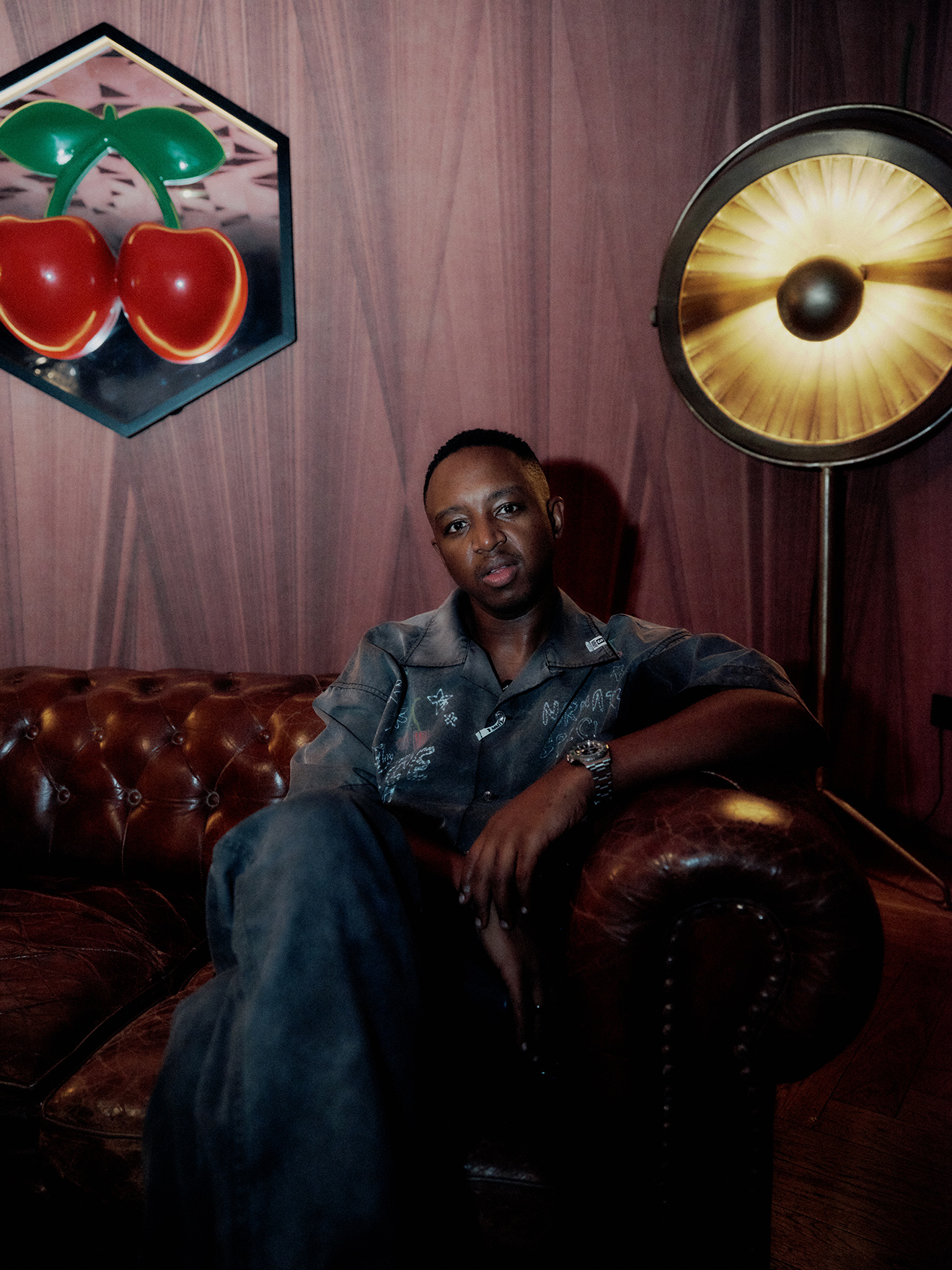
“The feeling of being [abroad] and building from scratch for me has evoked some sort of emotion that I had when I [first] started DJing” says Shimza. “Building from scratch has helped me be humble; to remember that, yes, you can be a ‘superstar’ where you come from… But there’s a different world with a different energy and a different way that people look at you, and you have to work your way up [all over] again. It just takes me back to the morals and feelings that I had coming up. It’s different worlds.
“[Being here] reminds you of where you come from… [Where] you see the people that were there from day one when no one knew about you. And then you move globally and sometimes it feels like you’re back where you started – because no one knows you here.”
 Credit: Carl Andile Holman & Alex Oelofse
That evening, Shimza and his team closed off an eight-week long residency at the historic Pacha, best known for its reputation as an international counterculture destination that predates Ibiza’s legacy as the clubbing destination of the world. The first Pacha was opened by Ricardo and Piti Urgell in Sitges near Barcelona in 1967, with the Ibiza venue following in 1973, originally at a relatively modest estate outside of town. Having expanded to host multiple venues around the world, including hotels, restaurants, resorts and clubs, there’s nothing modest about the place now. Key to its resilience is Pacha’s ability to embrace progress and hybridity, which Shimza has undertaken wholeheartedly with additions to his Shimza & Co residency line-up varied across South African favourites Darque and Tenoceans, as well as friends abroad from Damian Lazarus to Alex Wann and GORDO. For the final night’s proverbial cherry on top, he invited Africa’s most recent figurehead of pop and dance music’s multiplicity, Tyla.
With this addition, Shimza carefully enlists another strand of African music for club spaces; it’s an interesting move for a few reasons. Pacha’s history has always been entangled with Black music, from the soul and disco that shaped its early musical culture to the house music that transformed the island and, more recently, the African electronic artists who have taken up residency there. With Shimza and his cohort dictating the shape of the sounds in Pacha’s rooms, this moment signals a turn toward Afrocentric dance music that at one point in time had been denied the platform it now receives. For Banele Mbere of Major League DJz (who is in attendance tonight and shared the same stage with Shimza as prior residency guests), Tyla’s appearance is significant precisely because of what it represents beyond a guest slot.
“It’s been amazing so far, I love the fact that he’s brought more of our culture to the closing night with her. She’s done amazing things for our music so I think it’s good for different giants to come together and celebrate African dance music on the island together,” Banele says while seated for dinner at Pacha’s on-site restaurant.
 Credit centre: Carl Andile Holman & Alex Oelofse | Credit left and right: Pacha Ibiza
Ibiza’s growing relationship with African music doesn’t necessarily mean that Africans have arrived on equal terms though. Many of the DJs playing so-called Afro house are white men from Europe serving up a washed-out take on the sound, even while pioneers like Black Coffee have held high-profile residencies. Banele also highlights that the island remains prohibitively expensive for many of the people whose music now fills its clubs, however the cost of living in general is not an African problem, but rather a universal one. He explains that most European visitors fly in for a night, party and leave the following morning, over committing to the bill for a hotel. Add VISAs, longer flights and costly exchange rates to this, and the experience itself becomes a non-starter for anyone those factors apply to. However, Banele doesn’t see this as a long-term problem for those not lacking in disposable income from his home continent, if Ibiza happens to be a thing on anyone’s bucket list.
“We will see more affluent Africans on the island,” he tells me. “It will take some time because it’s very expensive to be here. But give it a few years; the island will adjust itself.”
 Credit: Pacha Ibiza
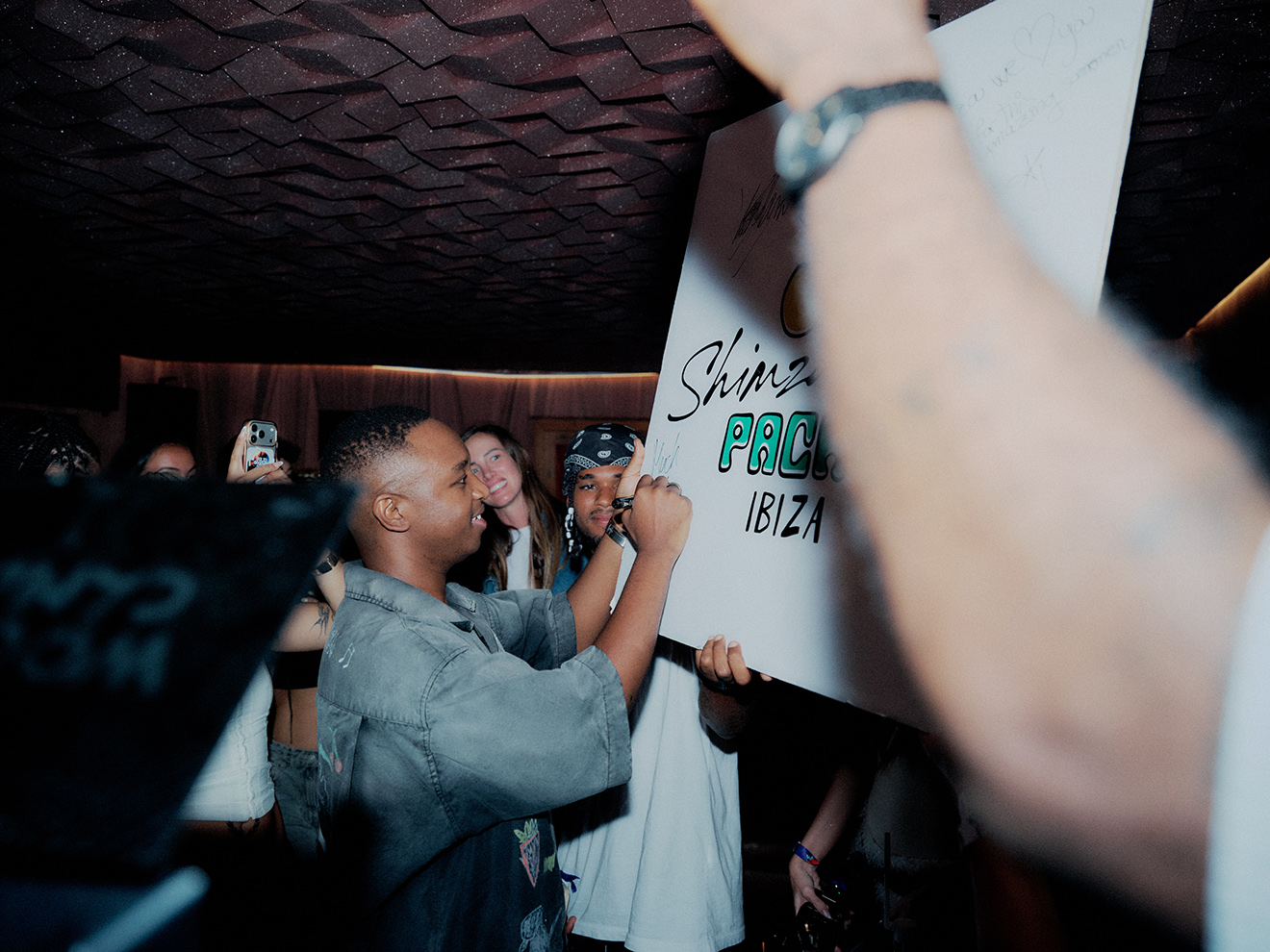
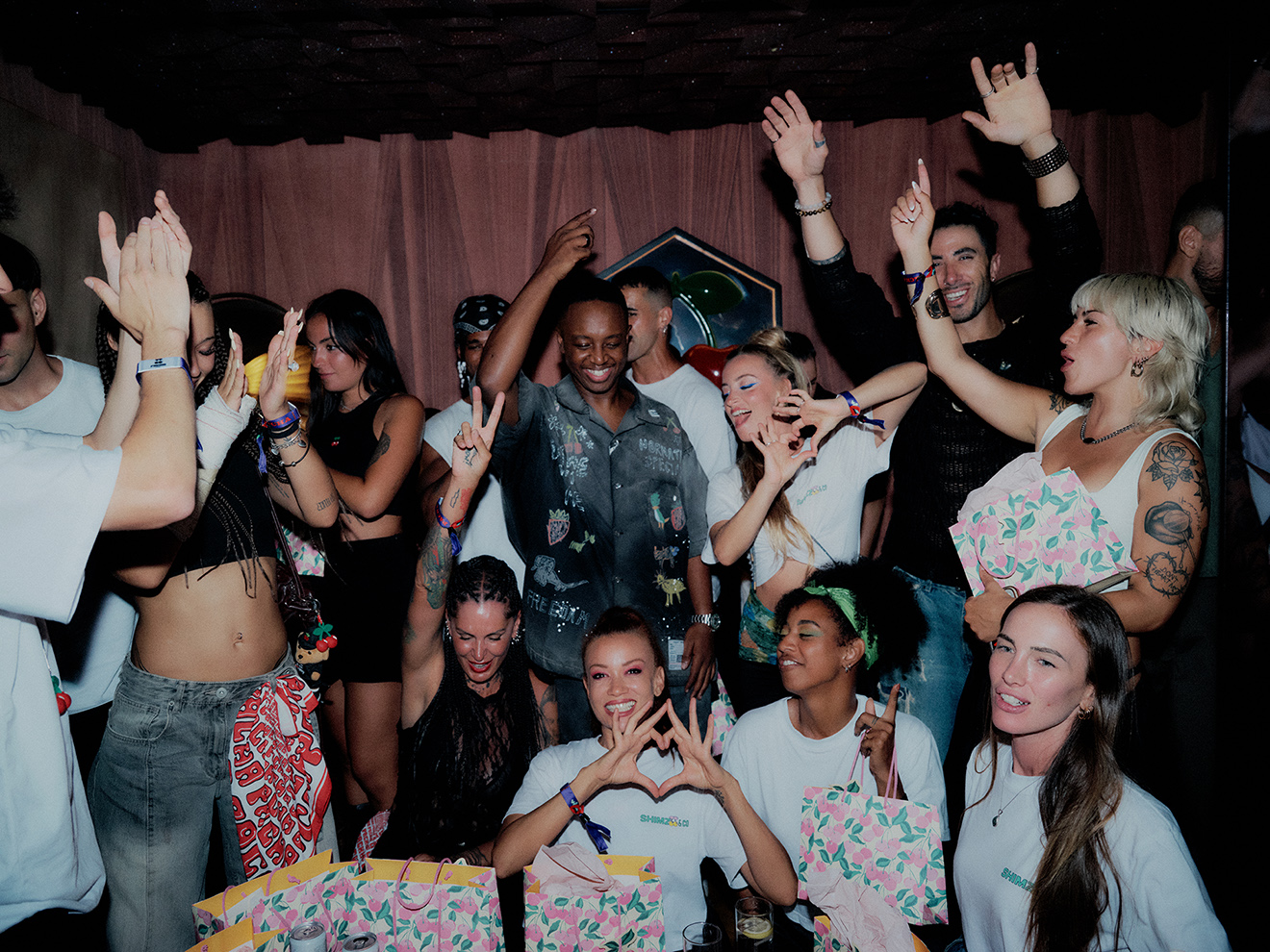
Upon arrival at Pacha’s flagship restaurant, Shimza sits at the head, signing what looks like a stack of cards from a ribbon-adorned powder-blue box. He’s surrounded by team members and friends alike, who seem to straddle work and play just as skillfully. On the right side of his denim shirt is Pacha’s unmistakable, hand-painted fruity motif. Glowing laptops, buzzing phones and wristbands get exchanged amongst blushing sashimi, plump oysters and hollowed edamame shells. A top-knotted waitress puts the club’s go-go dancers to shame as she balances a full tray one one hand, while placing a pair of elaborate cocktails down for his guests. Sweet, smoky aromas of umeshu and mezcal make the low light feel all the more easeful. For the man of the season, a simple glass of ice water. A dark-haired man gestures toward the menu for the rubia gallega (a highly-prized, and equally highly-priced, signature Spanish cut of beef), while his friend fights back a powerful yawn reserved for those who’ve lived through this night one too many times. One final go, and Shimza & Co’s residency will be complete.
While dinner gets underway, a clear-eyed man introduces himself as Mauro, with a firm handshake and a tour through the then-empty club. His demeanour says “designated driver” even as his thready denim shorts meld well with the laxness of the setting. As we ascend to the upper level, a tiny door is guarded by security, who makes way as Mauro ushers us inside. One swipe of a white keycard opens the second door to Ricardo’s; a lofty oasis room with a fully-stocked bar, plush sofas, a single full-length mirror and a widescreen TV broadcasting the stage below. A jagged ceiling keeps the growing club noise out and the intimacy of the interactions in.
 Credit: Carl Andile Holman & Alex Oelofse
In a quiet room off to one side, Shimza shares that one of the defining relationships in his career began with a simple act of care. Long before Kevin Oliveira became his tour manager, a chance encounter saw Kevin tending to him during a bout of sudden illness. So far from home and loved ones at the time, having Kevin at his hospital bed made all the difference. For Shimza, the choice of who he’d want to keep with him wasn’t hard to make; Kevin treated him as a person before he treated him as a prospect.
“This person took care of me when I was sick. That’s the best person to have with you on the road. He didn’t know me, but he helped me out, and he’s been with me ever since… People work with you, and not for you. That way you have a stronger sense of belonging and connection to what you want to achieve.”
It’s an unusually revealing description of an artist’s management philosophy. The people around Shimza seem to be more than employees, agents or managers who appeared as his career expanded; many of them have been with him long enough to remember when the career he celebrates today was just an idea. Malenah Sikakana, his current business partner, remembers those days.
“I met Shimza through his girlfriend, hanging out at home. We just connected from there; we’d sit in the house and dream about what it would be like to be international, and play the types of shows he used to aspire to,” she recounts as we sit inside this exclusive hideaway within one of the world’s most beloved clubs. “One day I said ‘fine, let me start reaching out to people and knocking on doors.’ Even seeing things materialise the way they are now is quite crazy. We’re literally living the dream we once talked about and a lot has been ignited through the shared relationships in this room.”
 Credit: Carl Andile Holman & Alex Oelofse
When Malenah’s load became difficult to manage, she enlisted the help of her little sister, Thabang (then 18 years old), who would take over her role in bookings while Malenah rose in the ranks. Today, she is a business partner across many of Shimza’s ventures, and Thabang has since moved on to managing Shimza’s social media.
“Shimza is a big brother and a big dreamer, and outside of that, he makes things happen,” says Thabang. “He’s an ideas man… as soon as inspiration hits him, he has to tell it to someone and we have to try to execute it. He’s a mastermind, he’s not just a DJ. There’s so much more to him than people often realise. I appreciate his brain!”
As artists become more successful, the people who knew them before the success can often fade into the background. Shimza’s story seems to work differently. Jarrad Treger of creative music agency Jet Black, reflects on the man he has come to know through the various roles he’s held within Shimza’s ecosystem.
“One thing, amongst the many that stood out to me about him is that… as much as you want to listen to what he’s doing, you’re drawn to watching him do it, which is a rare talent. He’s always stayed quite true to himself and something that people underestimate (along with his ambition and everything he’s achieved) is that he’s incredibly smart. That has commanded a lot of respect.”
“We pushed so hard,” continues Malenah. “There were times where we would do 10 shows in a day and all we wanted was to make it work, so we pushed more. We could do that because we knew that we had pulled in people that were always going to back us up, no matter what happened. Trust and loyalty is something that has really bonded us together.”
 Credit: Pacha Ibiza
Downstairs, the club is now at capacity. Every inch of Pacha’s several floors are populated with partygoers, and the emotional intimacy of Ricardo’s is replaced with intimacy of a more physical kind, where fans and photographers struggle for lung capacity and clean sightlines. The same dark-haired man from downstairs summons another Galician Blonde over to his table from the crowded stage-side to join him in his spacious VIP booth.
By the time Shimza’s set is about to begin, we snake through an effervescent hallway toward the stage. Suddenly the guests upstairs have become indistinguishable from those downstairs; Mauro stands guard at Shimza’s right shoulder, looking far more serious about his designation. Tyla (having been tucked away in a green room on the other side of the club, after flying in directly from serenading the 2026 FIFA World Cup) is spirited when she takes the stage, embracing Shimza as plain-clothes security tightens the circle around the pair against a heaving crowd. Each of them clutch frosty cans of still water as Tyla asks everyone to raise their glasses. By this time it is 03:42AM, and there’s no longer any room to move, let alone dance. From the safety of the balcony, we watch a sea of phone screens illuminate the pair as they take requests from the audience to sing along to, instead. For a moment, this Mediterranean warmth felt a lot less far-flung from our South African home.
 Credit: Carl Andile Holman & Alex Oelofse
“Things are for everyone,” Shimza insists, when asked for his final word to African artists coming up in his wake. ”You must never think that things are for other people. If you want to achieve anything, you are capable and worthy of achieving whatever you want. We’re in a different time, and no one can tell you what you can and cannot do.”
In Shimza’s mind, there’s nowhere he can’t go. With each set, each club anthem, and each new home he and his teams create, he reminds us not to let our imaginations become more restrictive than reality already is. Perhaps that is what it means to “like things” at this scale: to live beyond the desire for others’ beautiful places and experiences; to imagine oneself belonging in them, creating them, and making sure to keep the best company by your side on the journey.







Leave A Comment
You must be logged in to post a comment.