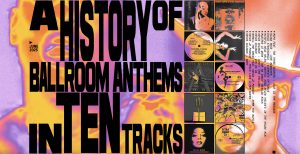
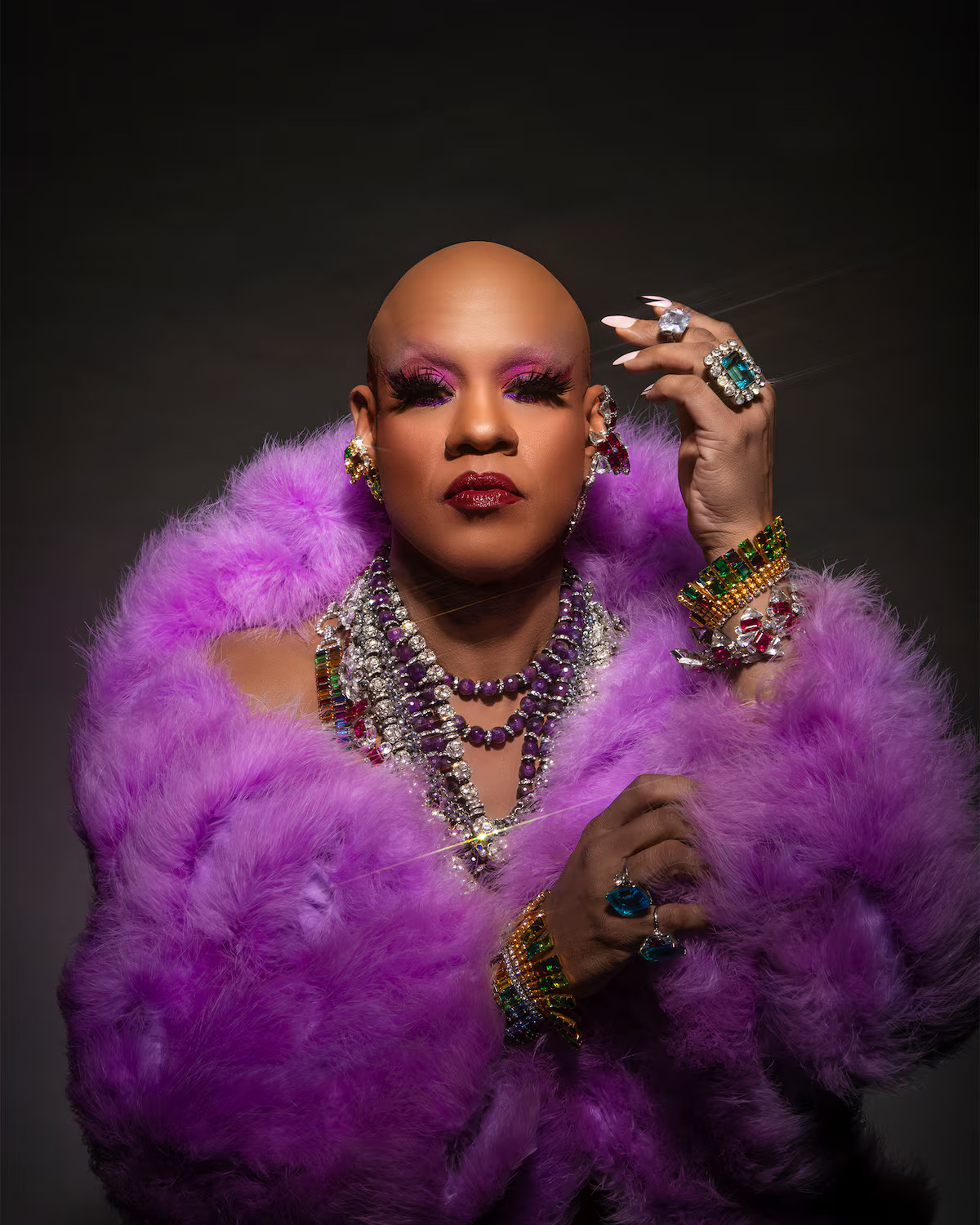
Kevin Aviance is one of the most iconic ballroom artists of all time, still leading the movement today. From Diana Ross to Kevin JZ Prodigy, he charts the history of a genre shaped by New York’s queer underground.
Like any snubbed diva, Aviance took revenge in the best way possible: by making a name for himself hosting outrageous afterhours all over downtown. “I won Club Kid of the World—Leigh Bowery [the boundary-smashing, gender-bending art star] gave me the trophy,” he explained. “I ran away from ballroom and became more of a club kid.”
During this golden era of New York nightlife, Aviance met producer Jerell Black, whose pioneering mix of crunchy drums and spoken-word diva vocals helped shape a ballroom sub-genre called bitch tracks, played during the most aggressive moments of a ball.
At this point, ballroom was evolving from a Black, Brown and queer subculture born in Brooklyn and the Bronx into a global phenomenon. Balls brought together different houses of dancers, battling in a style known as “vogue” and presenting fashion looks divided into themed categories. The all-night events became a space for exploring new music, dance and style.
Amid this melting pot, “ballroom” the genre was born. Black had already had a ballroom hit with 1995’s “Tyler Moore Mary” featuring Franklin Fuentes. When he discovered Aviance’s larger-than-life persona, he knew he had a star on his hands. For the new queen of downtown, it marked a re-entry into the scene that had jilted him.
“Music was always my thing,” Aviance said. “I didn’t know I was gonna start recording, but I had a need to become something. I just didn’t know what.” He’s since become one of the most ubiquitous ballroom artists of all time. “Cunty”, his first track with Black, is a bona fide anthem–blasted on runways and catwalks the world over for 30 years. His acerbic bitch tracks and booming baritone are the blueprint for ballroom vocalists.
Since “Cunty” dropped in 1996, five Aviance singles (“Din Da Da,” “Rhythm Is My Bitch,” “Alive,” “Give It Up” and “Strut”) have topped the Billboard Dance chart. But they’re more than just run-of-the-mill club cuts. While ballroom can have a scrappy, DIY ethos, Aviance champions sleek aesthetics and glossy, hi-fi production. It’s aspirational: his tracks are battle hymns, prepping voguers to leave it all on the runway. Having worked with foundational producers like Junior Vasquez and François K, he’s become a nucleus of ballroom music.
In 2022, Aviance reached a new level of fame when Beyoncé sampled “Cunty” on “Pure/Honey.” It was a full-circle moment. “It was absolutely the fiercest thing ever, girl,” he grinned. “I love how the ballroom has gotten so big and so worldwide, and seeing the beautiful dancers and queens and the trans community coming together. I love being Black and being part of that.”
A few weeks after this interview, Aviance was hospitalised with septic poisoning and pneumonia—a wake-up call after three decades of touring. He posted a photo of flowers he received from Beyoncé during his convalescence–even the world’s biggest pop star knows the importance of his contributions to dance music.
To sketch ballroom’s history, you must start with the Black and Latine communities where it all began. For this list, Aviance drew from his time as a ballroom legend, as well as from soul and R&B records spun at the peak of the ball. Picture sweat flying off the dancers, or the MC screaming for a performer to get their tens. “[Ballroom] is the most incredible subculture,” Aviance said. “They give you the drama, they give you the kiki, they give you the carrying on. Everyone that’s involved in it, they protect it.” He laughed again. “They’ll let you in, but you might not get out, girl!”
MSFB feat. The Three Degrees – “Love is the Message”
[Philadelphia International Records, 1974]
This was part of my coming up. It was the first time I ever heard a ballroom-type track in a nightclub. This song is all about the runway for me. It’s old school but it’s very reminiscent of when we’d go till the early hours. This was a 7 AM song and you’d play it from beginning to end. And the kids would go up, honey. They would go up.
Diana Ross – “Love Hangover”
[Motown, 1976]
Oh, come on! “Dun-dun-dun-da-dun-dun… Over…!” That’s the reason, the only reason! That one part in the middle is ever-y-thing! It’s so fierce! There’s this incredible story about Madonna performing at Paradise Garage in the early days. Larry Levan called a friend and told her to stop by—turns out it was Grace Jones, and she brought Diana Ross. They both had huge records out at the time. They came through the doors, people were screaming, they’re in jeans and tank tops or whatever, and they sat on the stage and started signing autographs while Madonna’s performing. So fierce.
David Xtravaganza – “Elements of Vogue”
[Extravaganza Records, 1989]
This is up there with “Love is the Message” for me. I love the cadence: “Vogue in beat is a dance obsession / A form of total self-expression / With no regards to your obsession / Elements of vogue.” I knew him! To know that he left this with us, for us, it’s just so incredible. I was there to see him perform. My god, the way these kids used to vogue—he would wear these overalls, and he would turn his body completely around while in the overalls.
He was like a god to me. I was screaming, I was obsessed. We were still living in D.C. at the time [and] I remember we came to New York, we went to the Sound Factory and went straight from the club to the record store to buy that track. It was on our record player for days. Then I met Johnny Dynell, the producer, and he said, “You know, you should redo ‘Elements of Vogue!’ I said, ‘Yeah no, I’d love to, but I’m actually not going to touch that one.'”
Hateful Head Helen – “Hateful Head Helen (Helen’s In The House Mix)”
[Too Hot Records, 1989]
Candy [Jordan, AKA Sweet Pussy Pauline] is a dear friend, and someone I really look up to. She’s from that old school. She was that trans voice—that girl that was talking about getting the boy, how big the dick was and everything like that. Her voice is so legendary, she’s been sampled by everyone. I’m really into voices. When you hear my voice, you know it’s me, and that’s because of all these other influences. When you hear Candy J, or Franklin Fuentes, or any of the other bitch track artists, you know exactly who they are.
Masters at Work – “The Ha Dance (Ken/Lou Mixx)”
[Cutting Records, 1991]
I don’t know if Masters At Work knew that this track would be the basis of ballroom—but the ballroom sure did. The first time I heard it I was in D.C. I think it was Sunday night at Tracks, which was a really famous Black party. “The Ha Dance” by itself is flawless, but having the ballroom just putting that little loop on it made it an incredible piece of work. You know, the sample comes from the Eddie Murphy movie Trading Places, when he’s on the plane with Dan Aykroyd.
Kevin Aviance – “Cunty (The Feeling)”
[Strictly Rhythm, 1996]
My family are all landscape contractors, so the “feeling like a lily, feeling like a daisy, feeling like an orchid” lyrics came from my childhood. Then the word “cunty” is something I heard at the piers, which was where you’d go to see all the kids carrying on and stuff. And I remember seeing these two young boys with a broken mirror, going, “Oh, this is cunty!” I remember writing it down on my hand, like “You gotta remember that word.” When I heard the track, I thought “Ooh, that’s cunty!” And that was the name of the song.
It was very avant-garde. I’d never heard anything like it. I’d never heard the word before, and I know that people hadn’t heard the word before. Although, I remember going to perform it in London, and it got banned, actually. People were looking at me like I was half crazy. They were like, “Who are you calling a cunt?”
Kevin Aviance – “Din Da Da”
[Wave Music, 1997]
I used to be on this huge lip-syncing tour around the US, going to all the local bars in every city. I lip-synced to George Kranz’s “Din Daa Daa” for many years. When I got a record contract, I decided that I wanted to cover it. François Kevorkian was like “if we do this, we’re gonna have to get approval from Kranz himself.” The first time, we did it with the late, great [producer] Louie Balo and it didn’t go well. I couldn’t scat, and I was really upset about it. The next person I worked with was DJ Gomi, my dear friend and producer. He got me to work with a jazz vocalist and after a couple of weeks, I could scat a little bit—that helped me to position all the words. It was another magical moment. I had no idea the song was going to turn into a hand performance record— that was really fab.
Byrell The Great feat. Kevin JZ Prodigy – “Hymm For Battle”
[It’s Not a Ki Records, 2019]
Byrell The Great is a DJ and producer with the most incredible ballroom tracks. He’s a master at these beats. I love this song so much. He’s a newer artist I discovered since I’ve been DJing. The drums, everything about it. Everything he touches is genius. It just sounds so good. I can’t think of a track he’s done that’s not on fire. It’s the energy and workmanship. He has three or four albums out already, and they’re all on fire.
Kevin JZ Prodigy – “FEELS LIKE A FEM QUEEN”
[Duetti (Migration), 2022]
Let me tell you something. When it comes to the ballroom voice, the cadence, the call, all that stuff—that’s all Kevin. And they all get it from him. He’s definitely the GOAT of ballroom MCs. We’ve become really close friends. I love Kevin with all my heart. I don’t know half the songs—I just know when I hear his voice, I’m going to love it.
Kevin Aviance – “Body”
[Voss Music, 2023]
“Body” was given to me by its original artist, Cherie Lily. She’s also my music manager, and when all the Beyoncé stuff was happening, we had to put some music out. She asked me if I wanted to do a cover, so I chose one of her songs! We did my version with DJ Gomi, and I loved it. If you got body, then you got body. You could be a skinny girl with body. You could be a big girl with body. You could be petite with body. You flaunt it, you have that pride when you got body, you know what I mean? It’s about how sexy you feel. It’s your armour that’s not to be messed with.









Leave A Comment
You must be logged in to post a comment.